10Stationary Traffic (Parking and Stopping)
Ruhender Verkehr
Learn the German rules for parking and stopping, including the critical distinction between Halten (stopping) and Parken (parking), no-parking and no-stopping zones, distance requirements from intersections and crosswalks, parking at night, and the use of the Parkscheibe. These rules are among the most frequently tested on the theory exam.
Stopping vs. Parking (Halten vs. Parken)
German traffic law draws a sharp legal distinction between stopping (Halten) and parking (Parken), and this difference is fundamental to understanding all stationary traffic rules. Under StVO section 12, stopping means voluntarily bringing your vehicle to a halt for a reason other than traffic conditions (red light, traffic jam, etc.). Parking means leaving your vehicle or stopping for longer than 3 minutes. This 3-minute rule is the central dividing line tested on the exam.
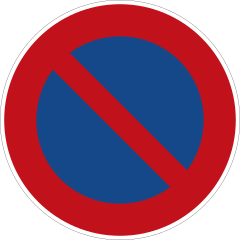
If you stop your car and remain with it, and the stop lasts 3 minutes or less, you are merely stopping (Halten). The moment you leave your vehicle, or the moment 3 minutes have elapsed — whichever comes first — you are legally parking (Parken). This matters because many zones prohibit parking but allow stopping. Sign 286 (eingeschränktes Haltverbot) prohibits parking but permits stopping for up to 3 minutes, allowing you to briefly pick up passengers or load goods. Sign 283 (absolutes Haltverbot) prohibits any voluntary stop, even for a few seconds.
There is one important nuance: if you leave your vehicle, you are parking regardless of how quickly you return. Leaving the vehicle means being unable to respond immediately to the vehicle (for example, you walk into a shop). However, if you step out briefly to assist a passenger with luggage while remaining at the vehicle, you are still considered to be stopping. The exam tests these edge cases. A classic question is: 'You stop to run into a bakery for 2 minutes. Is this stopping or parking?' The answer is parking, because you left the vehicle.
The consequences of the distinction extend to liability. If you are merely stopping, you must remain able to move the vehicle immediately if required (for example, to make way for an emergency vehicle). If you are parking, the vehicle must be properly secured: engine off, parking brake engaged, steering locked, vehicle in gear (manual) or in Park (automatic), and windows closed on the street side. On slopes, turn the front wheels toward the curb (downhill) or away from the curb (uphill) to prevent the vehicle from rolling.

Tips
- The 3-minute rule is absolute: even if you are loading heavy furniture, once 3 minutes pass, you are legally parking. Plan loading activities in areas where parking is allowed.
- When in doubt about whether you are stopping or parking, assume you are parking and check whether parking is permitted at that location.
Common Mistakes
- Believing that staying near the vehicle (but outside it) counts as stopping. Once you leave the vehicle, it is parking, regardless of the duration.
- Forgetting that sign 283 (absolute Haltverbot) means no stopping at all — not even to pick up a passenger. Only forced stops (traffic conditions) are excepted.
- Assuming hazard lights make stopping legal. Turning on hazard lights does not create a legal exception to no-stopping zones.
No-Parking and No-Stopping Zones
Beyond the explicit signs 283 and 286, German law establishes numerous locations where stopping or parking is prohibited by default, even without signs. These distance-based rules are among the most frequently tested topics on the theory exam. Knowing the exact meters required is essential.
Parking is prohibited within 5 meters of an intersection or junction measured from the corner point of the intersecting road edges. This ensures that vehicles approaching the intersection have clear sightlines. Parking is also prohibited within 5 meters before a pedestrian crossing (Zebrastreifen) — note that this applies to the approach side only, not after the crossing. Additionally, parking is forbidden within 10 meters of a traffic light if a parked vehicle would obscure it, and within 15 meters of a bus or tram stop sign (sign 224) — measured from the sign in both directions. On roads with a marked bus stop area on the roadway (the zigzag line), parking on the entire marked area is forbidden.
Stopping (not just parking) is prohibited in several critical locations: on the roadway next to a solid edge line that leaves less than 3 meters of clearance for passing traffic, on acceleration and deceleration lanes (Beschleunigungs- and Verzögerungsstreifen), within intersections, on pedestrian crossings, on railway crossings and up to 10 meters before a railway crossing (St. Andrew's cross), and in front of property entrances and garage driveways.
The distance rules get more specific in certain contexts. On roads with bike lanes (Radfahrstreifen or Schutzstreifen), you may never stop on the bike lane itself. Near tram tracks, you must leave enough space for trams to pass. On narrow roads, you must leave at least 3.05 meters of passable width for other traffic — this is the minimum width for an emergency vehicle. If your parked vehicle leaves less than this width, you are parked illegally even if no signs prohibit parking.
A frequently tested scenario involves parking near corners. The 5-meter rule from intersections applies even on small residential streets. Many exam questions show a vehicle parked 3 or 4 meters from a corner and ask whether this is permitted. The answer is always no. Some cities have extended this to 8 meters at corners with bicycle lanes, and the exam may reference the newer rule.
Tips
- Memorize the key distances: 5m from intersections and pedestrian crossings, 10m from traffic lights and railway crossings, 15m from bus/tram stops.
- The 3-meter clearance rule is a practical test: imagine an ambulance 3.05m wide needing to pass. If it cannot, your parking is illegal.
- On one-way streets, you may park on either side of the road. On two-way streets, you must park on the right side in the direction of traffic.
Common Mistakes
- Confusing the 5m intersection rule with a 10m rule. The correct distance from intersections is 5 meters (not 10).
- Parking within 15 meters of a bus stop sign, thinking the rule only applies to the marked bay on the road. The 15m zone extends from the sign itself.
- Forgetting that the no-stopping rule at pedestrian crossings means you may not stop even briefly to let someone out of the car.
Parallel Parking and Parking Direction
In Germany, you must always park in the direction of traffic flow (in Fahrtrichtung). On a two-way road, this means your vehicle must be on the right side of the road, facing the direction of travel. Parking against the direction of traffic (on the left side of a two-way road) is prohibited and will result in a fine, because it requires you to cross oncoming traffic twice — once to park and once to leave. The only exception is on one-way streets, where you may park on either side.
Parallel parking (Längsparken) along the roadside is the most common form of parking on German streets. Your vehicle must be parked as close to the right edge of the road as practicable, parallel to the curb. If there are marked parking spaces, you must park within the marked boundaries. Double parking (parking in a second row alongside already-parked vehicles) is prohibited and constitutes a significant obstruction, subject to increased fines.
Angle parking (Schrägparken) and perpendicular parking (Querparken) are only permitted where signs or road markings indicate it. In perpendicular parking areas, take care when reversing out — visibility is typically very poor, and you must yield to all traffic on the road. Some exam questions test whether you should reverse into a perpendicular space (recommended for better visibility when leaving) or drive in forwards.
When parking on a hill, additional precautions are required. On a downhill slope, turn your front wheels toward the curb so that if the vehicle rolls, it will roll into the curb and stop. On an uphill slope, turn the wheels away from the curb for the same reason. Always engage the parking brake firmly and leave a manual-transmission vehicle in first gear (facing uphill) or reverse gear (facing downhill). Automatic vehicles should be placed in Park. These measures are mandatory under StVO and are tested on the exam.
Tips
- When parallel parking, the standard technique is: pull alongside the vehicle in front, reverse at 45 degrees until your rear wheel is near the curb, then straighten. Leave about 50cm from the curb.
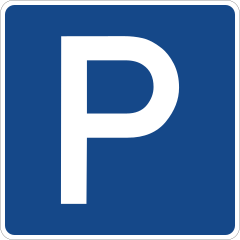
- Check for parking meters, Parkschein automats, or Parkscheibe requirements before walking away. The P sign (314) alone does not mean unlimited free parking — always check supplementary signs.
Common Mistakes
- Parking on the left side of a two-way road facing against traffic. This is illegal regardless of how briefly you stop.
- Leaving excessive distance from the curb. Parking more than about 30-50cm from the edge can obstruct traffic and may be fined.
- Forgetting to turn wheels toward the curb on downhill slopes. If the vehicle rolls, it will enter the roadway and cause an accident.
Parking at Night and Lighting Rules
German law has specific requirements for how vehicles must be parked at night, and these rules are regularly tested on the theory exam. The general rule is that vehicles parked on the road outside of well-lit built-up areas must be made visible to other road users. Inside built-up areas with functioning street lighting, no additional lighting is required for parked vehicles.
Outside built-up areas, or on roads without sufficient street lighting, you must either use parking lights (Standlicht / Begrenzungsleuchten) or place a warning triangle or approved reflective device to mark the vehicle. Parking lights must be activated on the side of the vehicle facing traffic — for a vehicle parked on the right side of the road, the left parking light must be on. Modern vehicles often have a one-sided parking light feature (right or left only) for exactly this purpose. Leaving full headlights or dipped beam on overnight will drain the battery and is not required.
Vehicles and trailers over 3.5 tonnes that are parked outside built-up areas at night on the road must additionally be marked with at least one retroreflective warning device (such as a warning triangle or reflective plate). This requirement also applies to vehicles with attached trailers. Inside built-up areas, the same rules apply on roads without adequate lighting.
A common exam scenario involves parking on a dimly lit road within a village. The question tests whether parking lights are required. The answer depends on whether the street lighting is considered adequate. As a practical rule: if you cannot clearly see your parked vehicle from 50 meters away, use parking lights. When parking in a marked parking space off the roadway (such as a parking lot), no special lighting is needed even at night, because the vehicle is not obstructing traffic on the road.
Tips
- If you park on an unlit road at night, use the parking light on the traffic-facing side. Most cars have a switch to activate only the left or right parking light.
- Reflective warning vests should be in the vehicle and accessible without stepping into traffic. While not directly a parking rule, breaking down and parking on a dark road requires visibility.
Common Mistakes
- Leaving no lights on when parked outside a built-up area at night, assuming the vehicle is visible. On dark rural roads, an unlit parked vehicle is nearly invisible.
- Using full headlights (Fernlicht or Abblendlicht) instead of parking lights (Standlicht) when parked at night, draining the battery needlessly.
- Assuming parking lights are never needed inside built-up areas. On streets without adequate lighting, they are required even within a town.
Parking Discs and Pay Parking
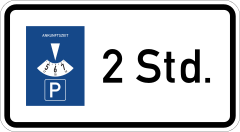
Many parking zones in Germany require the use of a parking disc (Parkscheibe) to limit parking duration. The requirement is indicated by supplementary sign 1053-34 placed under the parking sign (314) or no-parking sign (286). The Parkscheibe is a standardized blue-and-white card with a rotating clock dial that shows your arrival time.
The correct procedure for using the Parkscheibe is as follows: set the arrival time to the next full half hour after your actual arrival. For example, if you arrive at 14:12, set the disc to 14:30. If you arrive at 14:30 exactly, set it to 14:30 (not 15:00). Place the disc visibly behind the windshield on the dashboard. If the maximum parking time is 2 hours and you set it to 14:30, you must leave by 16:30. Traffic enforcement checks the disc time and the current time to determine whether you have exceeded the limit.
Pay parking (Parkschein required) is indicated by the P sign with a supplementary sign showing a ticket symbol or the text 'mit Parkschein.' You must purchase a ticket from the Parkscheinautomat (parking meter) and display it on the dashboard. The ticket shows the expiration time. Some cities have transitioned to digital payment via smartphone apps, but a physical ticket or active digital session is still required where signs indicate Parkschein.
Resident parking zones (Bewohnerparken) are marked with a supplementary sign showing the zone designation (e.g., 'Bewohner mit Parkausweis Zone A frei'). Non-residents must follow the posted time limits and use a Parkscheibe or pay for parking. Residents with the correct permit may park without time limits. The exam tests whether you understand that these zones still allow non-residents to park, just with restrictions.
Exceeding the permitted parking time results in escalating fines. Overstaying by up to 30 minutes costs 20 EUR. From 30 minutes to 1 hour, the fine is 25 EUR. Over 1 hour costs 30 EUR, over 2 hours costs 35 EUR, and over 3 hours costs 40 EUR. While these fines are moderate, frequent violations are recorded, and in some cities, persistent offenders may face increased enforcement attention or towing.
Tips
- Always carry a Parkscheibe in your vehicle. They cost about 1-2 EUR and are available at gas stations, auto shops, and some supermarkets. Not having one when needed results in a fine.
- Digital Parkscheiben exist but must be officially approved (DIN-compliant). A smartphone app showing the time does not replace a physical or approved electronic Parkscheibe.
- Check the time limits carefully. Some zones change rules by time of day (e.g., 2 hours during the day, unlimited at night). The supplementary signs indicate the valid times.
Common Mistakes
- Setting the Parkscheibe to the exact arrival time instead of rounding up to the next half hour. The rule requires rounding up, and setting an exact time like 14:12 is incorrect.
- Placing the Parkscheibe on the rear shelf or somewhere not visible through the windshield. It must be on the dashboard, visible from outside.
- Forgetting to display the Parkscheibe in a zone where it is required and assuming the 3-minute stopping exception applies. If you park (leave the vehicle), you need the disc regardless of duration.
Key Rules
Parking is defined as leaving your vehicle or stopping for longer than 3 minutes. Everything shorter is stopping.
Why: The distinction determines which zones you may use. Many areas allow stopping but prohibit parking, enabling brief drop-offs without creating long-term obstructions.
Example: You pull over in a zone marked with sign 286 (eingeschränktes Haltverbot) to drop off a friend. You stay in the car and the friend exits in under 2 minutes. This is legal stopping. If you got out and walked to a shop, it would become illegal parking.
Penalty: Parking in a no-parking zone: 25 EUR. Parking in a no-stopping zone: 25-50 EUR, rising with obstruction or duration.
No parking within 5 meters of an intersection or pedestrian crossing.
Why: Parked vehicles near corners and crossings block the view for drivers and pedestrians, making it impossible to see approaching traffic or people about to cross.
Example: You are looking for parking and find a space 3 meters before a residential intersection. Even though no sign prohibits parking, you must not park here because the 5-meter rule applies by law.
Penalty: Parking too close to an intersection: 35 EUR. If causing obstruction: 55 EUR. If causing an accident: criminal liability.
No stopping or parking within 15 meters of a bus/tram stop sign (sign 224).
Why: Buses need space to pull in and out of stops safely, and passengers need clear sightlines when crossing the road after exiting the bus.
Example: A bus stop sign is on the roadside. You must keep a distance of at least 15 meters from the sign in both directions. If the stop has road markings (zigzag lines), the entire marked area is off-limits.
Penalty: Stopping or parking in a bus stop zone: 55 EUR. If blocking the bus: 70 EUR and 1 point.
Always park in the direction of traffic flow. On two-way roads, park on the right side only.
Why: Parking against traffic requires crossing the oncoming lane twice (to park and to depart), which is dangerous and unpredictable for other road users.
Example: On a two-way residential street, you must park with your vehicle facing the same direction as traffic on the right side. On a one-way street, you may park on either side.
Penalty: Parking against the direction of traffic: 15-25 EUR. If causing obstruction or danger: higher fines.
At night outside built-up areas (or on unlit roads), parked vehicles must be marked with parking lights on the traffic-facing side.
Why: An unlit vehicle parked on a dark road is invisible and creates a severe collision hazard for approaching traffic.
Example: You park your car on the roadside of a rural road at night. You activate the left-side parking light (Standlicht links) so that approaching traffic can see your vehicle from a distance.
Penalty: Failing to light a parked vehicle at night: 20-35 EUR. If an accident results, significant civil liability.
Related Traffic Signs
Video Resources
Halten und Parken — alle Regeln für die Theorieprüfung
Complete overview of stopping vs. parking rules, distance requirements, sign meanings, and the most common exam questions on stationary traffic.
Parkscheibe richtig einstellen — so geht es
Step-by-step guide to using the German parking disc correctly, including the rounding rule, placement, and what happens when you exceed the time limit.