9Driving Maneuvers
Verkehrsverhalten bei Fahrmanövern
Master the essential driving maneuvers tested on the German driving theory exam: turning, overtaking, lane changes, merging, and the critical mirror-signal-shoulder check (Schulterblick). This lesson covers the legal requirements, correct sequences, and common pitfalls for each maneuver.
Turning (Abbiegen)
Turning is one of the most accident-prone maneuvers in everyday driving, and the German theory exam tests it extensively. Whether you are turning left (links abbiegen) or right (rechts abbiegen), the procedure must follow a strict sequence: mirror check, signal, shoulder check (Schulterblick), position, speed, turn. Failing to perform even one of these steps correctly can result in a dangerous situation and will cost you points on the exam.
When turning right, you must position your vehicle as far to the right as practicable. Before turning, check your right mirror and perform a right shoulder check to look for cyclists and pedestrians who may be traveling alongside you in a bike lane or on the sidewalk. Cyclists have the right to continue straight even when you are turning right, and collisions between right-turning vehicles and straight-going cyclists are among the most common fatal accidents in German cities. You must yield to pedestrians crossing the road you are turning into.
When turning left, you must move to the center of the road or into the left-turn lane if one exists. On roads without a dedicated left-turn lane, position your vehicle just to the right of the center line. Oncoming traffic has right of way, so you must wait until there is a safe gap before completing your turn. When two vehicles turning left meet from opposite directions at an intersection, the default German rule is to pass in front of each other (voreinander abbiegen), unless road markings or the intersection layout direct you to pass behind each other (hintereinander abbiegen).
At traffic lights with a green arrow filter (Grünpfeil), you may turn right on red, but you must first come to a complete stop and yield to all other traffic, including pedestrians. The Grünpfeil is a small green arrow sign mounted next to the red light; it is not the same as a green arrow signal built into the traffic light itself. When the arrow is a lit signal within the traffic light, you may proceed without stopping, as cross traffic will have a red light.
Tips
- Always perform the shoulder check (Schulterblick) immediately before turning, not several seconds earlier. Conditions change rapidly.
- When turning left at an intersection with oncoming traffic also turning left, watch for vehicles hidden behind the oncoming left-turners.
- Reduce speed before the turn, not during it. Braking in a turn reduces tire grip and can cause skidding.
Common Mistakes
- Forgetting the right shoulder check when turning right — this is the number one cause of cyclist fatalities at intersections.
- Cutting corners when turning left, crossing into the oncoming lane before reaching the center of the intersection.
- Confusing the Grünpfeil sign (must stop first) with a green arrow traffic light signal (may proceed without stopping).
Overtaking (Überholen)
Overtaking (Überholen) in Germany follows strict legal rules codified in StVO sections 5-7. The general principle is that overtaking must happen on the left. Overtaking on the right is prohibited on regular roads and on the Autobahn, with narrow exceptions. Before you begin any overtaking maneuver, you must verify that it is safe, legal, and necessary.
The correct overtaking procedure has five phases. First, check your interior mirror and left mirror to ensure no vehicle behind you is already overtaking or about to overtake. Second, signal left. Third, perform a left shoulder check (Schulterblick) to cover the blind spot. Fourth, pull out and pass the slower vehicle with a safe lateral distance — at least 1.5 meters from cyclists, pedestrians, and e-scooters inside built-up areas, and at least 2 meters outside built-up areas. Fifth, signal right, check your right mirror, and merge back only when you can see the overtaken vehicle fully in your interior mirror.
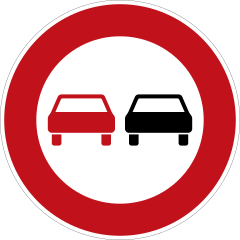
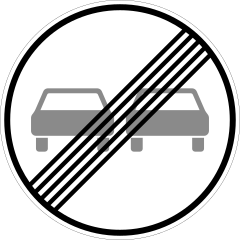
Overtaking is prohibited in several situations: when visibility is insufficient (curves, hilltops, fog), at pedestrian crossings (Zebrastreifen), at railway crossings and 240 meters before them when barriers are visible, when sign 276 (Überholverbot) is posted, and when road markings (solid center line) prohibit it. You may not overtake when doing so would require exceeding the speed limit. The vehicle being overtaken must not increase its speed while you are passing; this is a legal obligation under StVO section 5.
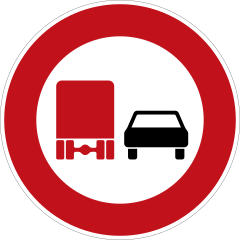
On the Autobahn, overtaking on the right is generally forbidden, but there are two important exceptions. First, in congested traffic (Kolonnenverkehr) where all lanes are occupied and traffic is moving slowly, you may pass vehicles on the right at a speed difference of no more than 20 km/h. Second, when vehicles in the left lane are stationary or moving very slowly, the right lane may move faster by up to 20 km/h. Heavy vehicles over 3.5 tonnes have additional restrictions under sign 277, which prohibits them from overtaking on certain stretches.
Tips
- If you are unsure whether you can complete the overtaking maneuver safely, do not begin it. Aborted overtaking attempts are extremely dangerous.
- On rural roads (Landstraßen), most fatal head-on collisions occur during failed overtaking. The closing speed between you and oncoming traffic can exceed 200 km/h.
- Remember: you may always overtake slow vehicles like tractors or horse-drawn carts even in a no-overtaking zone, as long as sign 276 does not explicitly include them.
Common Mistakes
- Overtaking without checking the left blind spot (shoulder check) — another vehicle may already be overtaking you.
- Merging back too early after overtaking, cutting off the overtaken vehicle. Wait until you see them fully in your interior mirror.
- Assuming overtaking on the right is always allowed on the Autobahn — it is only permitted in slow-moving congested traffic up to 20 km/h faster.
Lane Changes (Fahrstreifenwechsel)
Lane changes are a frequent source of accidents and a heavily tested topic on the German theory exam. Unlike overtaking, which involves temporarily leaving your lane to pass another vehicle and returning, a lane change means permanently moving from one lane to another. The procedure and responsibilities differ in important ways.
The correct lane change procedure follows the same mirror-signal-shoulder check pattern as turning. Check your interior mirror first, then the mirror on the side you intend to move toward, then signal your intention, and finally perform the shoulder check (Schulterblick) on the side of the lane change immediately before moving. The shoulder check is the most critical step because modern vehicle mirrors leave a blind spot large enough to hide an entire car, motorcycle, or cyclist. In Germany, failing to perform the Schulterblick is considered a serious driving error (Prüfungsfehler) during the practical exam.
The key legal principle for lane changes is that the vehicle changing lanes bears full responsibility. Under StVO section 7, a lane changer must not endanger or obstruct other road users. If you change lanes and cause another vehicle to brake or swerve, you are at fault regardless of whether they were speeding or driving aggressively. This means you must ensure the gap in the target lane is large enough and that no vehicle is approaching too quickly from behind.
On multi-lane roads and the Autobahn, you should generally stay in the rightmost lane that is practical for your speed (Rechtsfahrgebot — the obligation to drive on the right). Only move to the left lane for overtaking, and return to the right after completing the maneuver. In urban areas with multiple lanes going in the same direction, you may freely choose your lane when traffic is dense. The Reißverschlussverfahren (zipper merge) applies when a lane ends: vehicles must merge alternately, one from each lane, at the point where the lane ends — not early.
Tips
- Develop a habit of checking mirrors every 5-8 seconds while driving, so you always have a mental picture of the traffic around you before you need to change lanes.
- The zipper merge (Reißverschlussverfahren) works best when drivers merge at the very end of the closing lane. Merging too early reduces road capacity and creates unnecessary congestion.
Common Mistakes
- Signaling and changing lanes simultaneously. The signal must come first to give other drivers time to react — signal for at least 3 seconds before beginning the maneuver.
- Relying solely on mirrors without performing the shoulder check. The blind spot (toter Winkel) is real and large enough to hide a vehicle.
- Failing to respect the Rechtsfahrgebot on the Autobahn — cruising in the left lane when the right lane is free is a traffic violation (up to 80 EUR fine).
Merging and Joining Traffic (Einfahren und Einfädeln)
Merging onto a highway or joining traffic from a side road, property, or parking area is governed by clear priority rules in Germany. The general principle is simple: the vehicle entering the flow of traffic must yield to vehicles already on the road. This applies whether you are merging onto the Autobahn from an acceleration lane, pulling out of a parking space, or exiting a property (Grundstück) onto a public road.
When entering the Autobahn via an acceleration lane (Beschleunigungsstreifen), you must use the full length of the lane to match the speed of traffic on the main carriageway. You do not have the right of way — Autobahn traffic is not required to make space for you, though courteous drivers often will. Signal left, check your mirrors and left shoulder, and merge into a gap when it is safe. If the acceleration lane ends before you find a gap, you must stop at the end of the lane and wait, rather than forcing your way in.
When leaving a property, garage, parking space, pedestrian zone, or field path (Feldweg) onto a public road, you must yield to all road users — including pedestrians and cyclists on the sidewalk or bike lane. This is a common exam question. Many drivers forget that pulling out of a driveway means crossing the sidewalk, where pedestrians have absolute right of way. The same rule applies when leaving a traffic-calmed zone (Spielstraße, sign 325.2): you must yield to all traffic on the road you are entering.
The Reißverschlussverfahren (zipper merge) has specific legal standing in Germany under StVO section 7(4). When a lane ends or is blocked, vehicles from the closing lane and the continuing lane must take turns merging, one vehicle at a time, at the point where the lane ends. This is not optional courtesy — it is legally mandated. Blocking a merging vehicle deliberately is itself a traffic violation. The zipper merge reduces congestion and is more efficient than early merging, which the exam may specifically test.
Tips
- On the Autobahn, match the speed of the main lane while still on the acceleration lane. Merging at a significantly lower speed is dangerous and a common new-driver error.
- When pulling out of a parking space on the right side of the road, remember to check for cyclists approaching from behind before opening your door or pulling out.
- Use your mirrors and shoulder check even when leaving a driveway or garage. Pedestrians and cyclists on the sidewalk have right of way.
Common Mistakes
- Expecting Autobahn traffic to slow down or move over for you. You must yield — the acceleration lane is your tool to match speed, not a right-of-way lane.
- Merging too early when a lane ends instead of using the full lane length for a proper zipper merge at the merge point.
- Pulling out of a parking space without checking for approaching cyclists in the bike lane, which often runs right next to parked cars.
The Shoulder Check (Schulterblick)
The Schulterblick (shoulder check or head check) is one of the most important safety procedures in German driving and is heavily emphasized in both the theory and practical exams. It involves briefly turning your head to look over your shoulder to check the blind spot (toter Winkel) that your mirrors cannot cover. Every vehicle has blind spots — areas alongside and slightly behind the vehicle that are invisible in the interior and exterior mirrors.
The shoulder check is mandatory before every maneuver that involves a lateral movement: turning left, turning right, changing lanes, merging, pulling out of a parking space, and overtaking. It is also required when opening your door to exit a parked vehicle (the so-called Dutch reach technique is recommended: open the door with your far hand, which forces you to turn and look). The exam tests whether you understand when and why the shoulder check is needed, and in the practical test, failing to perform it is an immediate serious error.
The blind spot of a typical car extends roughly from the B-pillar to about 3 meters behind and to the side of the vehicle. This area is large enough to completely hide a motorcycle, bicycle, or small car. Trucks and buses have even larger blind spots, which is why cyclists must be especially careful around them. Modern vehicles may have blind spot monitoring systems (Totwinkelassistent), but these are driver aids only — they do not replace the legal and practical requirement to check over your shoulder.
The timing of the shoulder check is critical. It must be performed immediately before the maneuver, not several seconds beforehand. The traffic situation can change in a fraction of a second — a motorcycle traveling at 100 km/h covers nearly 28 meters per second. If you check your shoulder and then wait 3 seconds before turning, the motorcycle that was 84 meters away is now beside you. This is why the sequence is always: mirror, signal, shoulder check, maneuver — with the shoulder check happening last, right before you move.
Tips
- Practice the shoulder check until it becomes reflexive. It should be a quick, smooth glance — not a prolonged head turn that takes your eyes off the road ahead for too long.
- Adjust your mirrors correctly before driving: the interior mirror should frame the entire rear window, and each side mirror should show just a sliver of your own vehicle on the inner edge.
- Even with perfectly adjusted mirrors, blind spots remain. Technology like blind spot monitors supplement but never replace the Schulterblick.
Common Mistakes
- Performing the shoulder check too early in the sequence (before signaling) and then executing the maneuver seconds later when the blind spot situation has already changed.
- Only glancing at the side mirror instead of actually turning the head. The mirror check and the shoulder check are two separate steps that cover different areas.
- Skipping the shoulder check when turning right because 'there is nothing there.' Cyclists and pedestrians are often invisible in mirrors and approach quickly.
Key Rules
Always perform the shoulder check (Schulterblick) immediately before any lateral movement.
Why: Mirrors have blind spots large enough to hide a car or motorcycle. The shoulder check is the only way to verify the blind spot is clear.
Example: Before changing lanes on the Autobahn, you check your interior mirror, left mirror, signal left, then turn your head to look over your left shoulder. Only when the blind spot is clear do you begin the lane change.
Penalty: Failing to perform the Schulterblick during the practical exam is an automatic serious error. In traffic, it can cause collisions resulting in liability and fines of 30-80 EUR plus potential license points.
Overtaking must be done on the left. Right-side overtaking is only permitted in specific exceptions.
Why: Vehicles expect faster traffic on their left. Overtaking on the right catches drivers off guard and creates dangerous conflicts.
Example: On the Autobahn, you may only pass on the right in slow-moving congested traffic (Kolonnenverkehr) at no more than 20 km/h faster than the left lane.
Penalty: Illegal overtaking on the right: 100 EUR fine and 1 point in Flensburg. If endangering others: 120 EUR, 1 point, and possible driving ban.
Maintain at least 1.5m lateral distance from cyclists inside built-up areas and 2m outside.
Why: Cyclists are vulnerable road users. Insufficient passing distance causes turbulence that can destabilize a bicycle.
Example: You are overtaking a cyclist on a rural road (Landstraße). The road is 6 meters wide. You must leave at least 2 meters between your vehicle and the cyclist, which means crossing the center line into the oncoming lane if necessary.
Penalty: Violating the minimum passing distance: 30 EUR fine. If causing danger: 80 EUR and 1 point. If causing an accident: criminal charges possible.
The vehicle changing lanes always bears full responsibility. You must not endanger or force other vehicles to brake.
Why: Lane changes disrupt the flow of traffic. The changer must ensure complete safety before moving, since they are introducing the risk.
Example: You signal to change from the right lane to the left lane on the Autobahn. A vehicle approaching rapidly from behind in the left lane forces you to abort. Even though they may be exceeding the speed limit, you would be at fault if a collision occurred during your lane change.
Penalty: Causing an accident through an unsafe lane change: 30-80 EUR fine, 1 point, and full civil liability for damages.
The zipper merge (Reißverschlussverfahren) is legally mandatory when a lane ends.
Why: It maximizes road capacity by using the full length of the closing lane and reduces congestion compared to early merging.
Example: A construction zone reduces the road from two lanes to one. You stay in the closing right lane until the merge point, then alternate with vehicles from the left lane — one from each side.
Penalty: Deliberately blocking a merging vehicle: 20 EUR fine. Failing to let vehicles merge alternately disrupts traffic flow.
Related Traffic Signs
Video Resources
Richtig Überholen — Schulterblick und Sicherheitsabstand
Comprehensive walkthrough of the overtaking procedure including mirror checks, shoulder check timing, lateral distances, and common errors tested in the theory exam.
Fahrstreifenwechsel und Reißverschlussverfahren erklärt
Explains lane change rules on multi-lane roads and the Autobahn, including the legally mandated zipper merge procedure with animated diagrams.