11Special Traffic Situations
Besondere Verkehrssituationen
Prepare for the theory exam topics covering hazardous and unusual driving conditions: night driving, fog, rain and aquaplaning, ice and snow (including the winter tire mandate), vehicle breakdowns, accident procedures, and tunnel safety rules. These scenarios require specific knowledge and adapted driving behavior.
Night Driving (Fahren bei Dunkelheit)
Driving at night presents fundamentally different challenges compared to daytime driving. Visibility is drastically reduced, depth perception is impaired, and the risk of encountering drowsy or impaired drivers increases significantly. In Germany, dipped beam headlights (Abblendlicht) are mandatory whenever visibility conditions require them — this includes not only nighttime but also twilight, heavy rain, fog, snowfall, and when driving through tunnels.
Dipped beam headlights illuminate the road approximately 50-60 meters ahead. This means that at 50 km/h, you have roughly 3-4 seconds of visible road ahead of you. At 100 km/h, that drops to under 2 seconds — barely enough to react to an obstacle. The fundamental rule of night driving is therefore: never drive faster than you can stop within the visible distance (Sichtfahrgebot). On unlit rural roads with dipped beam, this effectively limits safe speeds to about 50-65 km/h, even though the legal speed limit may be 100 km/h.
High beam (Fernlicht) extends visibility to about 200 meters and should be used on unlit roads whenever possible. However, you must switch back to dipped beam when oncoming traffic is approaching (to avoid blinding them), when following another vehicle closely (to avoid blinding them through their mirrors), when driving through built-up areas with street lighting, and when road lighting is sufficient. If you are blinded by oncoming high beams, look to the right edge of the road, slow down, and if necessary stop. Never retaliate by switching on your own high beam — this creates a mutual blinding hazard.
A frequently tested exam topic is the distinction between different lights: Standlicht (parking lights, very dim, only for parked vehicles), Abblendlicht (dipped beam, standard for driving), Fernlicht (high beam, for unlit roads without oncoming traffic), Nebelscheinwerfer (front fog lights, for fog/heavy rain/snow, may only be used when visibility is substantially reduced), and Nebelschlussleuchte (rear fog light, only when visibility is below 50 meters). Using the Nebelschlussleuchte when it is not needed is itself a fineable offense because it blinds following drivers.
Tips
- Clean your headlights and windshield regularly. Dirt reduces headlight output by up to 40% and increases glare from oncoming lights on a dirty windshield.
- Keep your dashboard lighting dimmed at night to help your eyes stay adapted to the dark road ahead. Bright interior screens also reduce night vision.
- If you feel drowsy, stop immediately and rest. Drowsy driving at night is responsible for a disproportionate share of fatal accidents on Autobahns and Landstraßen.
Common Mistakes
- Driving faster than the visible stopping distance allows (violating the Sichtfahrgebot). At 100 km/h with dipped beam, the stopping distance far exceeds the 50-60m illuminated area.
- Forgetting to switch off high beam when cresting a hill, where it could momentarily blind an oncoming driver just over the crest.
- Using the rear fog light (Nebelschlussleuchte) in light rain or mist when visibility exceeds 50 meters, blinding the driver behind you.
Fog (Nebel) and the Nebelschlussleuchte
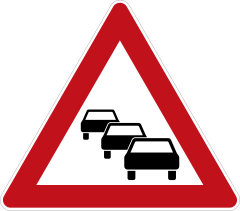
Fog is one of the most dangerous weather conditions for driving because it drastically reduces visibility while simultaneously making it difficult to judge distances and speeds. In Germany, fog-related pile-ups (Massenkarambolage) on the Autobahn are recurring tragedies, often involving dozens of vehicles. The theory exam tests your knowledge of the specific speed rules tied to visibility distances in fog.
The key rule is that your maximum speed in fog must never exceed a value at which you can stop within the visible distance. German driving schools teach three specific visibility-speed benchmarks that are frequently examined. When visibility is about 50 meters (you can just see the delineator posts on the Autobahn, which are spaced 50 meters apart), your maximum speed is 50 km/h. When visibility is about 100 meters, your maximum speed is approximately 80 km/h. When visibility is about 150 meters, you should not exceed 100 km/h. These are not arbitrary — they correspond to the stopping distances at those speeds.
The Nebelschlussleuchte (rear fog light) may only be activated when visibility drops below 50 meters due to fog, heavy snowfall, or heavy rain. This is a bright red light that is significantly more intense than normal tail lights, designed to make your vehicle visible to following traffic in dense fog. Using it when visibility is above 50 meters is prohibited because it is intensely glaring and can mask your brake lights, actually reducing safety. The fine for improper use is 20-25 EUR.
Front fog lights (Nebelscheinwerfer) have a different rule: they may be used whenever visibility is substantially reduced by fog, rain, or snow. They cast a wide, low beam that illuminates the road surface and road edges without reflecting off the fog layer as much as dipped beam headlights. They may be used alone or in combination with dipped beam. Unlike the rear fog light, front fog lights do not have the strict 50-meter visibility threshold, but they still should only be used when conditions genuinely warrant them.
In fog on the Autobahn, you must increase your following distance substantially. The normal 2-second rule should become at least a 4-5 second gap. If visibility is extremely poor (under 50 meters), consider leaving the Autobahn at the next exit and waiting for conditions to improve. Never stop on the hard shoulder in fog unless you have a genuine emergency — a parked vehicle on the shoulder in fog is at extreme risk of being rear-ended.
Tips
- Use the Autobahn delineator posts (Leitpfosten) as a visibility gauge. They are spaced exactly 50 meters apart. If you cannot see the next post, visibility is below 50 meters and your speed must be at most 50 km/h.
- In patchy fog, resist the temptation to accelerate when visibility temporarily improves. Dense fog patches can appear suddenly without warning.
- If you must stop in fog (breakdown), get all occupants out of the vehicle and behind the guardrail immediately. Place the warning triangle at least 100 meters behind the vehicle with hazard lights on.
Common Mistakes
- Driving 100 km/h or faster on the Autobahn in fog because 'the speed limit is 130.' The Sichtfahrgebot overrides posted speed limits — you must be able to stop within visibility.
- Turning on the Nebelschlussleuchte at the first sign of mist when visibility is still well above 50 meters, blinding following drivers.
- Tailgating in fog because you want to see the vehicle ahead for orientation. This is the primary cause of fog pile-ups. Maintain at least half your speedometer reading in meters as following distance.
Rain and Aquaplaning (Regen und Aquaplaning)
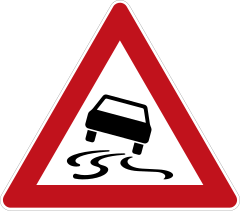
Rain creates multiple hazards for drivers. Wet roads increase stopping distances by approximately 50-100% compared to dry conditions. Road markings become slippery. Spray from other vehicles reduces visibility. And at higher speeds, the most dangerous phenomenon of all can occur: aquaplaning (Wasserglätte), where the tires lose contact with the road surface and ride on a layer of water, resulting in complete loss of steering and braking control.
Aquaplaning occurs when water accumulates on the road surface faster than the tires can disperse it. The risk increases with speed, tire wear (lower tread depth means less water displacement capacity), and water depth. At highway speeds with worn tires, even a few millimeters of standing water can cause aquaplaning. The signs of aquaplaning onset include: the steering suddenly feels very light, engine RPM rises suddenly (if in a lower gear), a distinctive hissing/rushing sound from the tires, and spray patterns visible on the sides of the vehicle.
If aquaplaning occurs, the correct response is critical and counterintuitive. Do NOT brake hard — the wheels are already floating and hard braking will lock them or trigger ABS on a surface with no grip. Do NOT make sudden steering movements. Instead, take your foot off the accelerator to gently reduce speed, hold the steering wheel straight, and wait for the tires to regain contact with the road. Declutch (press the clutch in a manual vehicle) to prevent engine braking from jerking the drive wheels. Once you feel the steering respond again, gently correct your course if needed.
To prevent aquaplaning, reduce speed in rain — especially in areas where water tends to pool (dips, underpasses, areas near drainage grates, ruts in the road surface). Ensure your tire tread depth is adequate. The legal minimum in Germany is 1.6mm, but tire experts and the ADAC recommend replacing tires at 3mm for summer tires and 4mm for winter tires, because water displacement capacity drops dramatically below these values. New tires have about 8mm of tread.
During heavy rain, you must turn on your headlights (Abblendlicht). If visibility drops below 50 meters, you may also activate the rear fog light. Spray from trucks can reduce visibility to near zero for several seconds when overtaking — be prepared for this and ensure your wipers are on the fastest setting before beginning to overtake a truck in rain.
Tips
- Increase your following distance to at least double the normal amount in rain. Stopping distances on wet roads are 50-100% longer than on dry roads.
- Avoid driving in the ruts created by heavy traffic, as water pools there. Drive slightly offset to find better contact with the road surface.
- Test your brakes gently after driving through a deep puddle. Water on the brake discs temporarily reduces braking effectiveness until the discs dry off from friction.
Common Mistakes
- Braking hard when aquaplaning begins. This achieves nothing because the tires are floating and can cause the vehicle to spin once they regain grip.
- Maintaining highway speeds (130 km/h) in heavy rain. The Sichtfahrgebot and increased stopping distance both demand significantly reduced speed, regardless of the posted limit.
- Driving with tires at the legal minimum tread depth (1.6mm) and assuming they are safe. At 1.6mm, water displacement is minimal and aquaplaning risk is extremely high.
Ice and Snow (Eis und Schnee / Winterreifen)
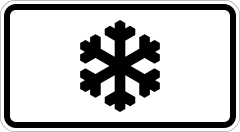
Winter driving conditions in Germany are governed by specific regulations, including the mandatory use of winter tires. Since 2010, German law requires situational winter tire use (situative Winterreifenpflicht): when road conditions include ice (Glatteis), packed snow (Schneeglätte), slush (Schneematsch), frost (Reifglätte), or black ice (Eisglätte), your vehicle must be equipped with winter tires or all-season tires marked with the Alpine symbol (three-peak mountain with snowflake). Tires marked only with M+S without the Alpine symbol were acceptable under a transition rule that expired on September 30, 2024.
The practical recommendation from driving schools and the ADAC is to use winter tires from October through Easter (the 'O bis O' rule — Oktober bis Ostern). This is not a legal requirement but a widely followed guideline that ensures you are prepared for the first frost. Winter tires must have at least 1.6mm of tread depth legally, but the recommendation is at least 4mm for adequate winter performance. Below 4mm, winter tire compounds lose much of their cold-weather grip advantage.
Driving on ice and snow demands fundamentally different techniques. Stopping distances can increase by 5-10 times compared to dry roads. At 50 km/h on dry road, the stopping distance is about 28 meters. On ice, the same speed requires 115-140 meters to stop. This means you must reduce speed dramatically and increase following distance to 5-6 seconds or more. Accelerate gently to avoid wheel spin. Brake gently and early — if ABS activates (you feel pulsing in the brake pedal), maintain pressure and steer in the desired direction. Avoid sudden steering movements.
Black ice (Blitzeis or Eisglätte) is particularly dangerous because the road appears wet but is actually covered in a nearly invisible layer of ice. Indicators of black ice include: temperature at or near 0 degrees C, a road surface that appears unusually dark and glossy, and a sudden feeling of lightness in the steering. Bridges, overpasses, and shaded areas freeze first because they lose heat from both surfaces. When you encounter black ice, the same rule as aquaplaning applies: do not brake hard, do not steer abruptly, gently reduce speed.
If you drive without winter tires when conditions require them, you face a fine of 60 EUR and 1 point in Flensburg. If you cause an obstruction (getting stuck), the fine increases to 80 EUR and 1 point. If you cause an accident, your insurance coverage may be reduced even if you were not otherwise at fault, because driving without appropriate tires is considered contributory negligence.
Tips
- Remember the 'O bis O' rule: winter tires from Oktober bis Ostern (October to Easter). This covers the realistic frost risk period in Germany.
- Carry snow chains (Schneeketten) if you plan to drive in mountainous areas. Some Alpine passes require them by sign. Practice fitting them before you need them.
- In freezing temperatures, clear all ice and snow from your vehicle before driving — not just the windshield. Snow on the roof can slide forward over the windshield when braking, or blow off and hit following vehicles.
Common Mistakes
- Assuming winter tires are only needed when there is visible snow on the road. The law requires them for ice, frost, and slush as well, which can be invisible.
- Using summer tires with good tread depth and thinking they are equivalent. Winter tires use a different rubber compound that stays flexible below 7 degrees C — summer tires harden and lose grip.
- Driving at normal speeds on a road that appears wet but is actually covered in black ice (Blitzeis). If the temperature is near freezing, assume the worst.
Breakdowns and Accident Procedures (Pannen und Unfallverhalten)
When your vehicle breaks down on the road, or when you are involved in or witness an accident, German law prescribes specific actions you must take. Failing to follow these procedures can result in fines, criminal charges (in the case of hit-and-run or failure to render assistance), and loss of insurance coverage.
For a breakdown (Panne), the procedure is: turn on hazard warning lights (Warnblinkanlage) immediately, put on your reflective safety vest (Warnweste) before exiting the vehicle, exit on the side away from traffic (passenger side on Autobahn), and place a warning triangle (Warndreieck) behind the vehicle. On the Autobahn, the warning triangle must be placed at least 100 meters behind the vehicle (walk along the guardrail, not the road, counting roughly 100 large steps). Outside built-up areas on regular roads, place it at least 50 meters behind. Within built-up areas, about 25 meters is sufficient. On the Autobahn, all occupants must leave the vehicle and stand behind the guardrail, never on the road or hard shoulder.
For an accident (Unfall), you are legally obligated to follow the rescue chain (Rettungskette). First, secure the accident scene: turn on hazard lights, put on your safety vest, set up the warning triangle at the appropriate distance, and ensure the scene is safe from further collisions. Second, check on injured persons and provide first aid (Erste Hilfe). Every driver in Germany is legally required to render first aid to the best of their ability. Failing to provide first aid when it is needed and possible is a criminal offense (unterlassene Hilfeleistung) under German law, punishable by up to one year imprisonment. Third, call emergency services: 110 for police, 112 for fire brigade and ambulance (112 works throughout the EU).
When calling 112, provide the five W's: Wo (where — exact location), Was (what happened), Wie viele (how many injured), Welche Verletzungen (what injuries), and Warten (wait for questions). Do not hang up until the dispatcher tells you to. If possible, send someone to guide the emergency vehicles to the scene.
Specific rules apply for minor accidents with only property damage and no injuries. If the other driver is present, exchange information (name, address, insurance details, license plates). If the other driver is not present (e.g., you damaged a parked car), you must wait a reasonable time (case law suggests about 30 minutes). Simply leaving a note is generally not sufficient — you should also report the incident to the police. Leaving the scene of an accident without identifying yourself (Unfallflucht) is a criminal offense, even for minor damage.
Tips
- Always keep a warning triangle, reflective vest, and first aid kit in your vehicle. These are legally required in Germany and must be accessible without unpacking the trunk.
- When placing the warning triangle on the Autobahn, hold it in front of you as a visible warning while walking to the 100-meter position. Use the delineator posts (50m apart) as distance guides.
- Save 110 (police) and 112 (ambulance/fire) in your phone, though 112 works without a SIM card or phone lock on any mobile phone in the EU.
Common Mistakes
- Placing the warning triangle too close to the vehicle (e.g., 20 meters instead of 100 meters on the Autobahn). At highway speeds, 20 meters gives following drivers less than one second to react.
- Forgetting to put on the reflective vest before exiting the vehicle. On the Autobahn, you are nearly invisible to high-speed traffic without it.
- Leaving the scene of a minor accident after placing a note on the damaged car, believing this satisfies the legal requirement. It does not — you must wait and/or report to police.
Tunnel Rules (Tunnelregeln)
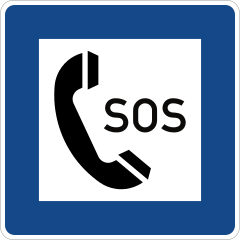
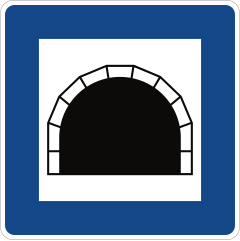
Tunnels present unique hazards that demand specific knowledge tested on the theory exam. When entering a tunnel (marked by sign 327), you must turn on your headlights (Abblendlicht) regardless of the time of day. Remove sunglasses so your eyes can adjust to the lower light level inside. Note the emergency exits, fire extinguishers, and emergency phones as you drive through — they are marked by illuminated signs along the tunnel walls.
In a tunnel, several maneuvers are strictly prohibited: making a U-turn (Wenden), reversing (Rückwärtsfahren), and stopping or parking unless forced by traffic conditions. You must maintain a safe following distance — at least equal to half your speedometer reading in meters (e.g., at 80 km/h, keep at least 40 meters). This distance is especially important in tunnels because smoke from a fire can fill the tunnel rapidly, reducing visibility to zero.
If a traffic jam forms inside a tunnel, stop your engine to prevent dangerous exhaust accumulation. Leave the key in the ignition (or keep the keyless fob in the vehicle). Do NOT lock the vehicle. Leave at least 5 meters of space to the vehicle in front so you can maneuver if needed. If the situation becomes dangerous (fire, heavy smoke), leave the vehicle immediately and proceed to the nearest emergency exit on foot. Emergency exits are marked with green running-figure signs and are typically spaced every 150-300 meters.
If a fire breaks out in a tunnel, this is one of the most dangerous possible driving scenarios. Turn off the engine, leave the key, take your phone and any passengers, and walk to the nearest emergency exit. Do NOT try to turn around or reverse out of the tunnel. Do NOT try to walk to the tunnel entrance or exit — emergency exits lead to separate safe passages or directly outside. Smoke in a tunnel rises to the ceiling, so if visibility is poor, crouch low where the air is cleaner. Use a wet cloth over your mouth and nose if possible. Call 112 from an emergency phone or your mobile once you are safe.
Tunnels are often equipped with traffic signals and variable message signs at the entrance. A red X above a lane means that lane is closed — do not enter. A green arrow means the lane is open. If you see red lights or a 'tunnel closed' signal at the entrance, stop and do not enter. Height restrictions (sign 265) at tunnel entrances must be observed strictly — striking the tunnel ceiling causes catastrophic damage and can trigger a tunnel closure.
Tips
- Note the location of emergency exits as you drive through tunnels. In an emergency, you need to know whether the nearest exit is ahead of or behind you.
- Tune your radio to the local traffic channel when entering long tunnels. Many German tunnels have dedicated tunnel radio frequencies that provide emergency instructions.
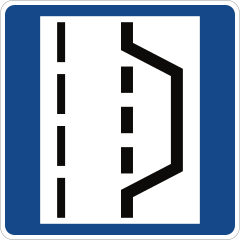
- If your vehicle breaks down in a tunnel, try to drive to a lay-by or the tunnel exit if possible. If you must stop, turn on hazard lights and use the emergency phone to report the breakdown.
Common Mistakes
- Attempting to reverse out of a tunnel during an emergency instead of using the emergency exits. Reversing into oncoming traffic in a smoke-filled tunnel is extremely dangerous.
- Keeping the engine running during a traffic jam in a tunnel, contributing to exhaust gas buildup that can become toxic in the enclosed space.
- Locking the vehicle and taking the keys when evacuating a tunnel. Emergency services need to move vehicles, and locked cars delay rescue operations.
Key Rules
Never drive faster than you can stop within the visible distance (Sichtfahrgebot).
Why: In fog, darkness, or heavy rain, the posted speed limit may be far higher than what is safe. You must always be able to stop before hitting an obstacle you cannot yet see.
Example: You are driving on a rural road at night with dipped beam headlights illuminating about 50 meters ahead. Even though the speed limit is 100 km/h, you must drive at most 50-60 km/h to be able to stop within the visible distance.
Penalty: Driving too fast for conditions (unangepasste Geschwindigkeit): 100-680 EUR, 1-2 points, up to 3-month driving ban depending on excess speed and consequences.
The rear fog light (Nebelschlussleuchte) may only be used when visibility is below 50 meters.
Why: The rear fog light is extremely bright and blinds following drivers. When used inappropriately, it reduces rather than increases safety, and can mask brake lights.
Example: You are on the Autobahn in dense fog and cannot see the next delineator post (50m spacing). You activate the Nebelschlussleuchte. When the fog lifts and you can see beyond 50 meters, you must turn it off immediately.
Penalty: Improper use of the rear fog light: 20-25 EUR fine.
Winter tires are mandatory when road conditions include ice, snow, slush, or frost (situative Winterreifenpflicht).
Why: Summer tires lose grip dramatically below 7 degrees C and are virtually useless on ice or snow. Winter tire compounds remain flexible and their tread pattern displaces snow and water effectively.
Example: It is November and overnight frost has formed on the roads. Even though no snow is visible, the road is covered in invisible frost (Reifglätte). You must have winter tires fitted to drive legally.
Penalty: Driving without winter tires in winter conditions: 60 EUR and 1 point. Causing obstruction: 80 EUR and 1 point. Causing an accident: 120 EUR and 1 point, plus potential insurance reduction.
Place the warning triangle at least 100m behind your vehicle on the Autobahn, 50m on other roads outside towns.
Why: At Autobahn speeds, drivers need at least 100 meters of warning to react and slow down. On rural roads, 50 meters provides adequate warning at typical speeds.
Example: Your car breaks down on the Autobahn hard shoulder. You put on your reflective vest, exit on the passenger side, and walk along the guardrail counting two delineator posts (50m each = 100m) before placing the warning triangle.
Penalty: Failure to secure an accident scene: 30 EUR. If an accident results from the unsecured scene: criminal charges and full liability.
In a tunnel emergency, leave the vehicle (keys in, unlocked) and walk to the nearest emergency exit. Never reverse or U-turn.
Why: Tunnels trap smoke and toxic gases at lethal concentrations within minutes. Emergency exits lead to pressurized safe passages. Reversing into traffic in a smoke-filled tunnel is suicidal.
Example: You are in a tunnel and see smoke ahead from a vehicle fire. You stop the engine, leave the key in the ignition, take your phone, and walk with your passengers to the nearest emergency exit marked by the green illuminated sign. You call 112 once safe.
Related Traffic Signs
Video Resources
Fahren bei Nebel, Regen, Eis — Besondere Verkehrssituationen
Covers driving techniques and legal rules for fog, rain, ice, and snow, including the Sichtfahrgebot, Nebelschlussleuchte rules, aquaplaning response, and winter tire requirements.
Unfallstelle absichern und Erste Hilfe — was tun beim Unfall?
Step-by-step walkthrough of the accident procedure: securing the scene, warning triangle placement, calling emergency services, and first aid obligations under German law.