14Driving with Trailers
Fahren mit Zügen
Understand the rules and techniques for driving with trailers in Germany: coupling and uncoupling procedures, weight limits for license classes B, B96, and BE, speed restrictions for trailer combinations, stability and swaying management, and reversing with a trailer. While lower in exam weight for Class B candidates, these topics appear regularly in the theory exam.
Coupling and Uncoupling (An- und Abkuppeln)
Coupling a trailer to a towing vehicle is a safety-critical procedure that must follow a specific sequence to prevent the trailer from becoming detached while driving — an event that can cause catastrophic accidents. The theory exam tests your knowledge of this procedure, and the practical driving test for Class BE specifically requires you to demonstrate it.
The coupling procedure begins with reversing the towing vehicle to the trailer so that the ball coupling (Kugelkopfkupplung) on the vehicle aligns with the trailer coupling mechanism (Anhängerkupplung). Before coupling, ensure the trailer is on level ground and secured with the jockey wheel (Stützrad) and the parking brake (Feststellbremse). Lower the coupling onto the ball and verify it has locked by trying to lift the coupling — it should not come off. Engage the safety cable or breakaway cable (Abreißseil): this cable connects the trailer brake to the towing vehicle so that if the trailer detaches, the cable pulls the trailer brake and brings it to a stop.
After mechanical coupling, connect the electrical plug (7-pin or 13-pin connector) for the trailer's lights. Then check ALL trailer lights: left indicator, right indicator, brake lights, tail lights, rear fog light, and reverse light (if equipped). Walk around the trailer and check the coupling visually, the safety cable attachment, tire condition, and load security. Release the jockey wheel by retracting and securing it. Finally, release the trailer parking brake.
Uncoupling follows the reverse order: apply the trailer parking brake first, then lower the jockey wheel until it takes the weight, disconnect the electrical plug, detach the safety cable, release the coupling from the ball, and drive the towing vehicle forward. The critical step many forget is applying the trailer parking brake first — if you uncouple without the brake, the trailer will roll, especially on even the slightest slope.
The safety cable (Abreißseil) is often a focus of exam questions. It must be attached to a fixed point on the towing vehicle (not the coupling itself, because if the coupling fails, the cable must still be connected). The cable must have enough slack to allow cornering without pulling, but not so much that it drags on the ground. If the trailer detaches, the cable activates the trailer's overrun brake, bringing it to a controlled stop.
Tips
- Always perform a 'tug test' after coupling: try to pull the coupling upward off the ball with both hands. If it lifts off, it is not properly locked. Re-seat it and test again.
- After connecting the electrical plug, have someone stand behind the trailer while you test each light function individually: left blinker, right blinker, brake, tail lights, reverse. A non-functional trailer light is a fine and a TÜV failure.
- Keep the coupling ball lightly greased to prevent wear and ensure smooth coupling/uncoupling. A dry, rusty ball causes excessive wear on both the ball and the coupling mechanism.
Common Mistakes
- Attaching the safety cable (Abreißseil) to the coupling ball or the coupling mount itself. If the coupling fails, the cable must remain connected to the vehicle — attach it to the vehicle frame or a designated attachment point.
- Forgetting to retract and secure the jockey wheel after coupling. A dangling jockey wheel can catch on road surfaces, especially speed bumps, and be ripped off or damage the trailer.
- Uncoupling the trailer before applying the parking brake. Even on apparently flat ground, the trailer can roll once the vehicle's weight is no longer holding it through the coupling.
Weight Limits and License Classes (Gewichtsgrenzen und Führerscheinklassen)
The German license class system defines strict weight limits for vehicle-trailer combinations, and understanding these limits is a core exam topic. The weight values refer to the permissible gross weight (zulässige Gesamtmasse / zGM) — the maximum total weight of the vehicle or trailer including all occupants and cargo, as stated in the vehicle registration document.
Class B (the standard car license) allows you to drive a vehicle up to 3,500 kg zGM. You may tow a trailer up to 750 kg zGM without any additional qualification. If the trailer exceeds 750 kg zGM, you may still tow it with Class B, but only if the combined weight of the vehicle and trailer does not exceed 3,500 kg. For example, if your car has a zGM of 2,100 kg, you could tow a trailer with a zGM of up to 1,400 kg (2,100 + 1,400 = 3,500). However, if your car weighs 2,500 kg zGM, you could only tow a trailer up to 1,000 kg zGM with Class B alone.
Class B96 is an extension of Class B that increases the combined vehicle-plus-trailer limit to 4,250 kg. It requires a one-day training course (typically 7 hours of theory and practical instruction) but no additional driving test. B96 is popular for towing larger camping trailers or boat trailers that slightly exceed the Class B limits. For example, with B96, a car of 2,500 kg zGM could tow a trailer of up to 1,750 kg zGM (total 4,250 kg).
Class BE allows you to tow trailers with a zGM of up to 3,500 kg — regardless of the towing vehicle's weight (as long as the towing vehicle is within Class B limits). BE requires a separate practical driving test with a trailer, but no additional theory exam. BE is needed for heavy boat trailers, horse trailers, large utility trailers, and similar loads. The total combination weight with BE can reach up to 7,000 kg (3,500 kg car + 3,500 kg trailer).
The actual weight of the combination must also not exceed the towing vehicle's technically permissible towing weight (technisch zulässige Anhängelast), which is specified by the vehicle manufacturer and shown in the registration document. Even if your license permits a heavier trailer, you may not exceed what your specific vehicle is rated to tow. Similarly, the trailer's actual load must not exceed its payload capacity (Nutzlast = zGM minus the trailer's unladen weight).
Another important concept is the nose weight (Stützlast): the vertical force the trailer coupling exerts on the towing vehicle's ball. The recommended nose weight is typically 4-7% of the trailer's actual weight, and must not exceed the values specified by both the towing vehicle and the trailer manufacturers. Too little nose weight causes instability and swaying. Too much puts excessive load on the rear axle and lifts the front, reducing steering grip.
Tips
- The exam frequently tests the 3,500 kg combined limit for Class B. Memorize it: vehicle zGM + trailer zGM must not exceed 3,500 kg if the trailer is over 750 kg and you only have Class B.
- Know the difference between Class B96 (up to 4,250 kg combined, training course only) and Class BE (trailer up to 3,500 kg own zGM, requires practical test). The exam tests both.
- Check your vehicle's registration document (Zulassungsbescheinigung Teil I) for field O.1 (technically permissible laden mass) and O.2 (permissible maximum laden mass in the member state). The towing capacity is in field O.1 or O.2 for the trailer, and the Anhängelast is noted separately.
Common Mistakes
- Confusing permissible gross weight (zGM) with actual current weight. The zGM is the maximum allowed weight including cargo. A 2,000 kg zGM trailer might weigh only 500 kg empty — but the limit is based on what it could weigh when fully loaded.
- Assuming that any trailer under 750 kg can be towed by any Class B vehicle. You must also check that the towing vehicle is rated for trailer use and that the combined weight does not exceed 3,500 kg.
- Overloading the trailer rear and having insufficient nose weight. This makes the trailer extremely prone to dangerous swaying at highway speeds.
Speed Limits and Restrictions for Trailers (Geschwindigkeit mit Anhänger)
Vehicles towing trailers are subject to different speed limits than solo vehicles in Germany. These limits are strictly enforced and are a frequent source of exam questions. The fundamental principle is that trailer combinations are heavier, less stable, and require longer stopping distances, so lower speeds are mandated.
The general speed limit for vehicles with trailers on the Autobahn and other motorways is 80 km/h. This applies regardless of the Autobahn's posted limit or recommended speed. On regular roads outside built-up areas (Landstraßen), the limit is also 80 km/h (compared to 100 km/h for solo vehicles). In built-up areas (Ortschaften), the standard 50 km/h limit applies equally to vehicles with and without trailers.
There is an exception that can raise the Autobahn limit to 100 km/h for certain trailer combinations, but only if specific conditions are met. The trailer and the towing vehicle must be technically approved for 100 km/h operation (Tempo-100-Zulassung). This approval requires: the towing vehicle must be equipped with a suitable stabilization system or ABS, the trailer tires must be rated for at least 120 km/h (speed index L or higher), the tires must be no older than 6 years, the trailer must have passed a special inspection, and a '100' sticker must be displayed on the rear of the trailer. Without this specific approval and sticker, the 80 km/h limit is absolute.
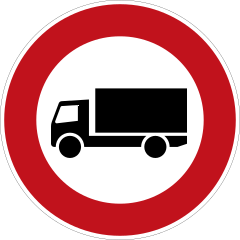
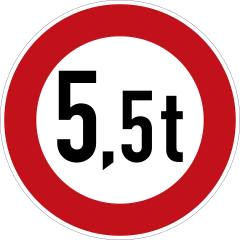
Other restrictions for vehicles with trailers include: sign 253 prohibits vehicles over 3.5 tonnes from certain roads, which may affect loaded trailer combinations; overtaking restrictions under sign 277 specifically target heavy vehicles; and certain Autobahn stretches have trailer-specific restrictions during weekends and holidays (the Ferienreiseverkehr rules). Trucks over 7.5 tonnes with trailers are subject to a weekend and holiday driving ban (Sonntagsfahrverbot), though this does not apply to passenger cars with trailers.
The stopping distance for a vehicle with a trailer is significantly longer than for the same vehicle without a trailer, due to the increased mass. This means that the following distance must be increased accordingly. On the Autobahn at 80 km/h, maintain at least a 50-meter gap (use the 50-meter delineator post spacing as a reference). In rain or other adverse conditions, increase this further. Emergency braking with a trailer is also complicated by the trailer's inertia, which can push the towing vehicle forward or cause jackknifing if the trailer brakes lock up.
Tips
- The default speed limit with a trailer is 80 km/h on Autobahn and Landstraßen. If the trailer does not have a '100' sticker on the back, do not exceed 80 km/h, even if other traffic is going faster.
- When you see a '100' sticker on a trailer, it means that specific combination has been approved for 100 km/h on the Autobahn. This does not apply to any other trailer on the same towing vehicle.
- Increase your following distance by at least 50% when towing a trailer compared to solo driving. The extra weight means longer stopping distances and less ability to evade obstacles.
Common Mistakes
- Assuming the 100 km/h Autobahn speed applies to all trailers. It only applies to combinations with a specific Tempo-100 approval, the correct tire ratings, and the visible '100' sticker.
- Driving 100 km/h on Landstraßen (rural roads outside towns) while towing a trailer. The limit is 80 km/h, not the normal 100 km/h for solo vehicles.
- Failing to account for the increased stopping distance when following other vehicles with a trailer. The combination is heavier and the brakes must work harder — maintain extra distance.
Trailer Stability and Swaying (Stabilität und Schlingern)
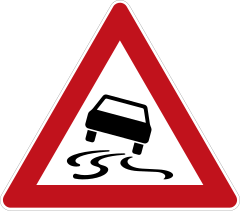
Trailer swaying (Schlingern or Pendelschlingern) is one of the most dangerous situations that can occur when towing. It typically manifests as a side-to-side oscillation that starts small and can rapidly amplify to the point where the driver loses control entirely. Understanding the causes and the correct response is critical for safety and is tested on the exam.
The primary causes of trailer swaying are: excessive speed (most common), improper weight distribution (too little nose weight / Stützlast, meaning too much weight behind the trailer axle), crosswinds (especially on bridges and open stretches), sudden steering inputs, and the aerodynamic wake of passing trucks. The physics is straightforward: when a force pushes the trailer to one side, the trailer pivots at the coupling point. If the restoring force (from nose weight pressing down on the coupling) is insufficient, each oscillation grows larger than the previous one, creating a self-amplifying pendulum effect.
The correct response when trailer swaying begins is counterintuitive but critical: do NOT brake hard and do NOT try to counter-steer. Both of these instinctive reactions will make the swaying worse. Instead, take your foot off the accelerator to gently reduce speed. Hold the steering wheel firmly in a straight-ahead position. If your vehicle has a trailer stability assist system, it will automatically apply individual wheel brakes to dampen the oscillation. As speed decreases, the swaying will diminish and eventually stop. Only once the trailer is stable should you carefully pull over and investigate the cause.
Preventing trailer swaying starts with correct loading. The heaviest items should be placed low and over or slightly ahead of the trailer axle. This ensures adequate nose weight (typically 4-7% of the trailer's actual weight, as stated in the trailer's documentation). A common guideline is that approximately 60% of the cargo weight should be ahead of the axle and 40% behind it. Never load heavy items at the rear of the trailer — this shifts the center of gravity behind the axle, dramatically reducing stability.
The 80 km/h speed limit for most trailer combinations exists specifically because swaying risk increases exponentially with speed. Even properly loaded trailers become less stable above certain speeds. Wind gusts, road irregularities, and steering inputs that are completely manageable at 80 km/h can trigger uncontrollable swaying at 100 km/h. This is why the Tempo-100 approval for trailers includes specific technical requirements (stabilization systems, proper tire ratings) — it is not merely a paperwork exercise.
Tips
- Before every trip with a loaded trailer, check the nose weight with a nose weight scale (Stützlastwaage, available for about 20 EUR). Too little nose weight (under-loaded front of trailer) is the most common cause of swaying.
- Practice the correct swaying response in a safe environment: foot off the accelerator, hold the wheel straight, wait for speed to decrease. Overriding your instinct to brake hard or steer could save your life.
- Reduce speed proactively when you encounter crosswind warnings (sign 114), when passing or being passed by trucks, and on bridges or exposed highway sections.
Common Mistakes
- Braking hard when the trailer begins to sway. This shifts weight to the front axle of the towing vehicle, lifting the rear and reducing the coupling force, which amplifies the swaying.
- Loading the trailer with heavy items at the rear 'to balance it out.' This is the opposite of correct loading — heavy items must be over or ahead of the axle.
- Exceeding 80 km/h with a trailer that does not have Tempo-100 approval because the road and traffic seem to allow it. The speed limit exists precisely because stability margins are thin at higher speeds.
Reversing with a Trailer (Rückwärtsfahren mit Anhänger)
Reversing with a trailer is widely considered one of the most challenging driving skills. The fundamental difficulty is that the trailer moves in the opposite direction to the steering input — when you turn the steering wheel to the right, the trailer moves to the left, and vice versa. This reversed steering response is unintuitive and requires practice to master. The Class BE practical driving test includes a reversing exercise.
The recommended technique for reversing with a trailer in a straight line is to place your hand at the bottom of the steering wheel (the 6 o'clock position). From this position, the direction you move your hand corresponds to the direction the trailer will go: move your hand right, the trailer goes right; move your hand left, the trailer goes left. This eliminates the mental reversal that confuses many beginners. Make very small steering corrections and move slowly — the slower you go, the more time you have to react.
When reversing a trailer around a corner (for example, into a parking space), start by positioning the vehicle and trailer in a straight line past the target space. Begin reversing and initiate the turn by steering in the opposite direction of where you want the trailer to go. As the trailer begins to angle into the target space, progressively straighten the steering to follow the trailer. Once the trailer is aligned with the target, straighten the vehicle to follow. The most common error is making too-large steering inputs, which causes the trailer to jackknife (form too sharp an angle with the vehicle). If this happens, stop, pull forward to straighten the combination, and start again.
Jackknifing occurs when the angle between the towing vehicle and the trailer exceeds approximately 90 degrees. Once this happens, further reversing can damage both the vehicle and trailer (the trailer corner can contact the vehicle body). Modern vehicles with trailer assist cameras or automated trailer reversing systems can help, but these technologies are not available on all vehicles, and the exam expects you to understand the manual technique.
Whenever you reverse with a trailer on a public road, you must ensure the maneuver does not endanger or unduly obstruct other road users. Use a spotter (Einweiser) whenever possible — someone standing outside the vehicle who can see the blind spots and guide you with hand signals. If no spotter is available, get out and check the area behind and around the trailer before beginning to reverse. On public roads, reversing should be minimized — plan your route to avoid situations that require complex reversing maneuvers.
Tips
- Practice reversing with a trailer in an empty parking lot before you need to do it in traffic. Start with straight-line reversing, then progress to turns. Use traffic cones as targets.
- The 'hand at the bottom of the wheel' technique genuinely works. Place your hand at 6 o'clock and the direction you move it matches the direction the trailer moves. Practice until it feels natural.
- If the trailer begins to jackknife (angle too sharp), stop immediately, pull forward to straighten, and restart. Continuing to reverse when jackknifed will damage the vehicle or trailer.
Common Mistakes
- Making large, sudden steering corrections while reversing. The trailer responds with a delay, and over-correction causes a pendulum effect that quickly leads to jackknifing.
- Reversing too quickly. Speed amplifies every error. Move at walking pace or slower, and use frequent mirror checks on both sides.
- Forgetting to check behind the trailer before reversing. Trailers have massive blind spots, and a small child or obstacle behind the trailer is completely invisible from the driver's seat.
Key Rules
Class B license: vehicle up to 3,500 kg; trailer over 750 kg only if combined weight does not exceed 3,500 kg.
Why: Heavier combinations require additional training and testing to handle safely. The weight limits ensure that drivers only operate combinations they are qualified for.
Example: Your car has a zGM of 2,200 kg and you want to rent a trailer for moving. With Class B alone, the trailer's zGM may not exceed 1,300 kg (2,200 + 1,300 = 3,500). For a heavier trailer, you need B96 (up to 4,250 kg combined) or BE (trailer up to 3,500 kg).
Penalty: Driving a vehicle-trailer combination that exceeds your license class: treated as driving without a valid license. Fine of up to 500 EUR or more, plus possible criminal charges for repeated offenses.
Maximum speed with a trailer is 80 km/h on Autobahn and Landstraßen unless the combination has Tempo-100 approval.
Why: Trailer combinations are heavier, less aerodynamic, and more prone to instability at high speeds. The 80 km/h limit provides a safety margin against swaying and extends braking distances to manageable levels.
Example: You are towing a camping trailer on the Autobahn. There is no speed limit sign, and other traffic is moving at 130 km/h. Your maximum speed is 80 km/h (or 100 km/h if your combination has the Tempo-100 approval with the visible sticker on the trailer).
Penalty: Exceeding 80 km/h with a trailer without Tempo-100 approval: fines start at 30 EUR for up to 10 km/h over, scaling up to 680 EUR, 2 points, and 3-month driving ban for extreme excess.
If the trailer begins to sway, take your foot off the accelerator and hold the steering straight. Do not brake hard.
Why: Hard braking during trailer swaying shifts weight forward, reducing the coupling force that stabilizes the trailer, and amplifies the oscillation. Gentle deceleration via engine braking reduces speed while maintaining coupling force.
Example: At 80 km/h on the Autobahn, a truck passes you and the wind buffet starts your trailer swaying. You resist the urge to brake, lift your foot from the accelerator, and grip the wheel firmly pointing straight ahead. Over the next 5-10 seconds, the speed drops and the swaying diminishes.
The safety cable (Abreißseil) must be attached to a fixed point on the towing vehicle, not to the coupling itself.
Why: If the coupling fails (which is the scenario the safety cable protects against), attaching the cable to the coupling means it will also fail. The cable must connect to the vehicle's frame or chassis so it can activate the trailer brake when the coupling separates.
Example: When coupling your trailer, you attach the safety cable loop to the designated hook on the towing vehicle's frame, below the bumper. You verify it has enough slack for tight turns but will not drag on the ground.
Penalty: Missing or improperly attached safety cable: can result in a fine during a roadside check and will cause TÜV/HU failure. If the trailer detaches without a functioning safety cable, criminal liability for the resulting accident.
Load heavy items over or slightly ahead of the trailer axle to ensure proper nose weight (4-7% of trailer weight).
Why: Correct nose weight presses the coupling down onto the tow ball, creating a stabilizing force. Insufficient nose weight (rear-heavy loading) allows the trailer to pivot freely, causing dangerous swaying at speed.
Example: You are loading a furniture trailer. The heaviest item (a washing machine) goes over the axle in the center. Lighter boxes go toward the front and rear, with slightly more weight forward. You check the nose weight with a scale and confirm it is within the 50-75 kg range specified for your trailer.
Related Traffic Signs
Video Resources
Anhänger fahren — Ankuppeln, Gewichtsgrenzen, Geschwindigkeit
Complete overview of trailer driving rules for the German theory exam: coupling procedure, license class weight limits (B, B96, BE), speed restrictions, and the Tempo-100 approval process.
Rückwärtsfahren mit Anhänger — Technik und Tipps
Step-by-step guide to reversing with a trailer, including the hand-at-bottom-of-wheel technique, correcting jackknifing, and practical exercises for building confidence.