4Road System
Straßenverkehrssystem
Understanding the German road network: road types from Autobahn to Spielstraße, lane usage rules, road markings, one-way streets, bus lanes, and cycling infrastructure.
Road Types in Germany (Straßenarten)
Germany's road network is hierarchically organized into several distinct road types, each with its own rules, speed limits, and characteristics. Understanding these categories is fundamental to driving safely and correctly — the rules that apply on an Autobahn are very different from those on a residential street, and the exam expects you to know these differences thoroughly.
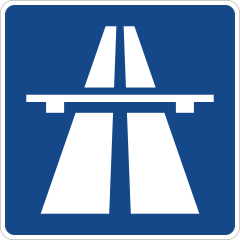
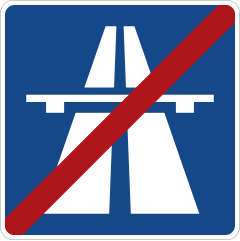
The Autobahn (motorway/freeway) is at the top of the hierarchy. Germany's Autobahn network is famous worldwide for sections without a general speed limit — but this reputation is somewhat misleading. While there is indeed no blanket speed limit on the Autobahn, a Richtgeschwindigkeit (recommended speed) of 130 km/h applies. This is not a legal limit — you will not be fined for exceeding it — but it has significant insurance implications. If you drive faster than 130 km/h and are involved in an accident, your insurance may assign partial liability to you even if the other party was technically at fault, simply because your excessive speed contributed to the severity of the accident. Additionally, many stretches of Autobahn DO have posted speed limits (signs 274), and these are legally binding. Temporary limits in construction zones are especially common. The Autobahn is marked by sign 330.1 (blue with white motorway symbol) at its start and sign 330.2 at its end. Only vehicles capable of sustaining at least 60 km/h are permitted. Pedestrians, cyclists, mopeds, and slow agricultural vehicles are prohibited.
Bundesstraßen (federal roads) are the next tier, marked with yellow signs and "B" followed by a number (e.g., B27). These are major inter-city roads that may be single or dual carriageway. Outside built-up areas, the default speed limit is 100 km/h for cars. Bundesstraßen may include at-grade intersections, traffic lights, pedestrian crossings, and access to properties — all things you never encounter on an Autobahn.
Landstraßen (rural/country roads) connect smaller towns and villages. They are typically single-carriageway with one lane in each direction, sometimes without a center line. The default speed limit is 100 km/h outside built-up areas, the same as Bundesstraßen. However, Landstraßen are statistically the most dangerous road type in Germany — they account for approximately 60% of all traffic fatalities despite carrying only about 40% of total traffic. The reasons are clear: high speeds, narrow lanes, oncoming traffic with no physical barrier, varied road users (tractors, cyclists, pedestrians), tight curves, limited visibility, and wildlife crossings. Drive with heightened caution on Landstraßen.
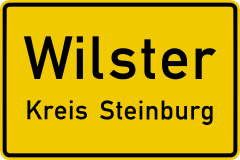
Within built-up areas (innerorts), identified by the yellow town entry sign (Zeichen 310), the default speed limit is 50 km/h. This applies automatically from the moment you pass the town entry sign, without any additional speed limit sign being necessary. The 50 km/h limit is based on the significantly more complex traffic environment within towns: intersections, pedestrians, cyclists, parked cars with doors potentially opening, children, buses stopping, delivery vehicles, and countless other hazards. Many residential areas within towns have further reduced limits of 30 km/h (Tempo-30-Zone, marked by sign 274.1).
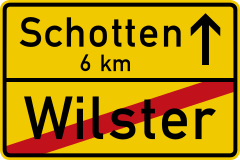
Understanding when you transition between these road types — and how the default speed limit changes accordingly — is critical. Passing town entry sign 310 means 50 km/h. Passing town exit sign 311 means 100 km/h (unless on an Autobahn). Entering an Autobahn (sign 330.1) means recommended 130 km/h. These transitions are tested frequently on the exam.
Tips
- When you see sign 311 (town exit), do not immediately accelerate to 100 km/h. Check for other signs that may impose a different limit, and be aware that the road immediately outside a town may still have hazards like intersections and pedestrians.
- On Landstraßen, the 100 km/h limit is the maximum — not the target. Adapt your speed to visibility, road width, curves, and conditions. Many Landstraße accidents happen because drivers treat 100 km/h as a mandatory speed.
- Remember the Autobahn Richtgeschwindigkeit of 130 km/h. Driving faster is legal (where no limit is posted) but affects your liability in an accident. For the exam, know that this is a recommendation, not a limit.
Common Mistakes
- Assuming the Autobahn has no speed limits anywhere. Many sections have posted limits (especially near cities, construction zones, and junctions). Always watch for sign 274.
- Forgetting that the default speed limit changes at the town boundary signs. You do not need to see an explicit '50' sign within a town — sign 310 alone establishes the 50 km/h limit.
- Treating all rural roads the same. A wide, well-maintained Bundesstraße is very different from a narrow, winding Landstraße — adapt your driving accordingly, even though both share the same default 100 km/h limit.
Lane Usage and Discipline (Fahrstreifenbenutzung)
Proper lane usage is a core driving skill in Germany, and the rules are more nuanced than many drivers realize. The fundamental principle is the Rechtsfahrgebot — the obligation to drive on the right. This is not merely a suggestion; it is a legal requirement under §2(2) StVO. You must drive as far to the right as is practicable, taking into account the road, traffic, and weather conditions.
On multi-lane roads within built-up areas (innerorts), the Rechtsfahrgebot is relaxed. When there are multiple marked lanes in your direction, you may freely choose any lane regardless of your speed (§7(3) StVO). This means that on a three-lane road within a town, you may stay in the middle or left lane even if the right lane is free. However, you should still use the right lane when it makes sense for your route, and you must move right when you would otherwise obstruct faster traffic.
On multi-lane roads outside built-up areas (including the Autobahn), the Rechtsfahrgebot is strictly enforced. You must use the right lane as your default. The left lane (and middle lane on three-lane roads) may only be used for overtaking. After overtaking, you must return to the right lane as soon as safely possible. "Lane hogging" (Schleichfahren auf der Überholspur) — staying in the left lane when the right lane is free — is a violation that carries a fine of 80-100 euros and 1 point in Flensburg. On three-lane Autobahns, the right lane is the normal driving lane, the middle lane may be used when right-lane traffic is dense or slow, and the left lane is exclusively for overtaking.
When changing lanes, the sequence is always: check mirrors, signal (Blinker), shoulder check (Schulterblick), then change. The shoulder check is essential because every vehicle has blind spots that mirrors cannot cover. Forgetting the shoulder check is one of the most common causes of lane-change accidents and is heavily penalized in both the practical exam and real-world driving.
The Reißverschlussverfahren (zipper merge) applies when a lane ends or is blocked. Traffic from both lanes must alternate one-by-one at the merge point — not earlier. Merging too early creates unnecessary congestion and is actually less efficient. The zipper merge should happen at the point where the lane actually ends, with drivers taking turns like the teeth of a zipper. Many German drivers do this intuitively on the Autobahn, but in practice, patience and cooperation are required.
On the Autobahn, the acceleration lane (Beschleunigungsstreifen) is for building up speed to match highway traffic before merging. You should accelerate to approximately the speed of the traffic in the right lane during the acceleration lane and merge smoothly. Traffic already on the Autobahn does NOT have to make room for you — you must find a gap. Conversely, the deceleration lane (Verzögerungsstreifen) at exits is where you should reduce your speed, not while still on the main carriageway.
Tips
- On the Autobahn, make it a habit to return to the right lane after every overtaking maneuver. Even if you plan to overtake the next vehicle soon, briefly moving right keeps traffic flowing.
- Master the lane-change sequence until it is automatic: mirror, signal, shoulder check, change. The shoulder check is the step most people skip, and it is the step that prevents accidents.
- At zipper merges, stay in your lane until the merge point and alternate fairly. Merging too early or trying to prevent others from merging at the end creates dangerous situations.
Common Mistakes
- Staying in the left or middle lane on the Autobahn when the right lane is free. This 'lane hogging' violates the Rechtsfahrgebot and is fined at 80-100 euros + 1 point.
- Merging too early at a lane reduction instead of using the full length of the ending lane and zipper-merging at the merge point.
- Trying to merge onto the Autobahn at too low a speed. The acceleration lane exists to build up speed — use its full length to match the speed of Autobahn traffic before the merge point.
Road Markings (Fahrbahnmarkierungen)
Road markings in Germany follow a standardized system that conveys critical information about lane boundaries, permitted maneuvers, and hazards. Understanding these markings is essential because they apply at all times and often determine whether a maneuver is legal or not.
The Leitlinie (guideline) — a dashed white center line — is the most common road marking. It separates opposing traffic flows on two-lane roads and indicates that overtaking is permitted if otherwise safe and legal. The dashes are typically 6 meters long with 12-meter gaps on rural roads, and shorter (3 meters with 6-meter gaps) within built-up areas. You may cross this line to overtake, but only when you have clear visibility, sufficient space, and no prohibition signs or other restrictions apply.
The Fahrstreifenbegrenzung (lane boundary line) — a solid white line — may NOT be crossed or straddled under any circumstances. A single solid white line between opposing traffic lanes means absolutely no overtaking (you cannot cross into the oncoming lane). A solid line between lanes going in the same direction means you must stay in your lane. The only exception is when the solid line delineates a parking area or similar zone — context determines the exact meaning.
A combination of a solid line and a dashed line running parallel means: the traffic on the side of the dashed line may cross (for overtaking), while traffic on the side of the solid line may NOT cross. You are bound by the line on your side of the road. This combination is common on hills and curves where one direction has clear visibility and the other does not.
The Sperrfläche (hatched area) — diagonal lines bordered by solid lines — marks an area that may not be driven on or over. These are commonly found at intersections to create a buffer zone, at highway exits/entrances, or in the center of roads to provide a separation between opposing traffic. Driving on a Sperrfläche is a violation.
Yellow road markings have a special status in Germany: they are temporary markings, typically in construction zones (Baustellen). When yellow markings are present, they override white markings. This is critical in construction zones where the road layout has been temporarily changed — follow the yellow lines, ignore the white ones. This is a very commonly tested exam topic.
Edge lines (Randmarkierungen) — typically solid white lines at the edge of the carriageway — mark the boundary of the road surface. They help with orientation, especially at night and in poor visibility. They also indicate where the road surface ends and the shoulder begins.
Stop lines (Haltelinien) are solid white lines across your lane at intersections, traffic lights, and stop signs. You must stop with your front bumper behind (not on) this line. At traffic lights, the stop line determines where sensors detect your vehicle. Stopping beyond the line may mean the sensor does not register your presence and the light never changes. At stop signs (Zeichen 206), you must come to a complete stop at the stop line — not at the edge of the intersection if a stop line exists.
Pedestrian crossings (Zebrastreifen) are marked with broad white parallel stripes across the road. Pedestrians have absolute right of way at these crossings. You may not overtake directly at or before a pedestrian crossing, and you may not stop or park within 5 meters before the crossing (measured from the marking, in the direction of travel).
Tips
- In construction zones, always follow yellow markings and ignore white markings. The exam tests this directly, and it is a common real-world confusion point.
- When you see a combined solid/dashed line, always check YOUR side. The line on your side of the road determines what you may do — the other side's line is irrelevant to you.
- At intersections with a stop line, stop at the LINE, not at the edge of the intersecting road. If visibility is poor from the line, you may then creep forward carefully to check traffic.
Common Mistakes
- Overtaking across a solid white center line. A solid line is an absolute prohibition on crossing — no exceptions, no matter how slow the vehicle ahead is.
- Ignoring yellow temporary markings in construction zones because the original white markings are still visible. Yellow always overrides white when both are present.
- Stopping on or beyond the stop line at a traffic light. You must stop with your front bumper behind the line. Going past it is technically a red light violation.
One-Way Streets and Special Zones (Einbahnstraßen und Sonderzonen)
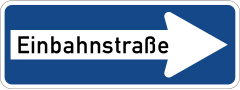
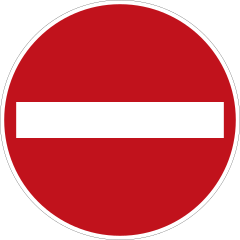
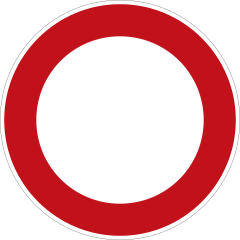
One-way streets (Einbahnstraßen) are marked with sign 220 — a blue rectangular sign with a white arrow pointing in the direction of traffic flow. At the opposite end, sign 267 (red circle with white horizontal bar — "no entry") prevents vehicles from entering against the flow. Understanding the special rules that apply in one-way streets is important for the exam and for daily driving in urban areas.
In a one-way street, you may drive on either side of the road, not just the right side. The Rechtsfahrgebot (obligation to drive on the right) is relaxed because there is no oncoming traffic to consider. You may also overtake on both sides (left and right), since the normal prohibition against overtaking on the right is based on the expectation of traffic in both directions. You may park on both sides of the street, subject to the usual parking rules and signs.
However, you must still drive at an appropriate speed and watch for pedestrians crossing, cyclists (who may sometimes be permitted to ride against the one-way direction — look for supplementary sign "Radfahrer frei" or "Radverkehr in Gegenrichtung"), and vehicles pulling out of parking spaces. One-way streets are common in urban centers, and their layout can be confusing in unfamiliar areas — pay close attention to signs.
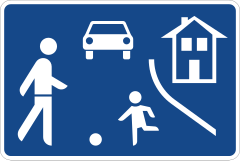
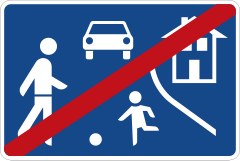
The verkehrsberuhigter Bereich (traffic calmed zone), commonly known as "Spielstraße" (play street), is marked by signs 325.1 (start) and 325.2 (end). These zones have the strictest speed rules of any road type in Germany. You must drive at Schrittgeschwindigkeit — walking speed — which courts have generally interpreted as 4-7 km/h, though some recent court rulings have set it as high as 10 km/h. At this speed, your vehicle barely moves faster than a pedestrian walking briskly.
In a Spielstraße, pedestrians have absolute priority and may use the entire road surface, including what would normally be the roadway. Children may play on the road. You must not endanger or obstruct any pedestrian. Parking is allowed ONLY in marked spaces — if there are no marked parking spots, you may not park at all, even if the road seems wide enough. Importantly, when leaving a Spielstraße, you must yield to ALL traffic on the road you are entering. You are treated as if you are exiting a private property (Grundstücksausfahrt), not as if you are coming from a regular road.
The Tempo-30-Zone (30 km/h zone) is another common special zone in residential areas, marked by sign 274.1 at the start and 274.2 at the end. Unlike a single 30 km/h speed limit sign (which is cancelled by the next intersection), a Tempo-30-Zone applies throughout the entire zone until you see the end sign. Within a 30-Zone, there are typically no priority roads — rechts-vor-links (right before left) applies at all intersections unless specifically indicated otherwise. Traffic calming measures such as speed bumps, road narrowing, and raised crosswalks are common.
The Fußgängerzone (pedestrian zone) is an area reserved for pedestrians, marked with sign 242.1. Motor vehicles are generally prohibited unless a supplementary sign specifically allows access (e.g., "Lieferverkehr frei 6-11 Uhr" — delivery vehicles permitted 6-11 AM). If you are permitted to enter, you must drive at walking speed and give absolute priority to pedestrians.
Tips
- In a Spielstraße (sign 325.1), think of yourself as a guest in a living room — pedestrians own the space. Drive at true walking speed (under 7 km/h) and be prepared to stop at any moment.
- When leaving a Spielstraße, treat it like exiting a driveway: you yield to absolutely everyone on the road you are joining, regardless of direction.
- In one-way streets, watch for cyclists who may be legally riding toward you (counter-flow cycling). Look for the supplementary sign indicating this.
Common Mistakes
- Driving 10-15 km/h in a Spielstraße and considering it 'walking speed.' True Schrittgeschwindigkeit is 4-7 km/h — barely above idle speed. Courts have fined drivers for exceeding this, even at seemingly slow speeds.
- Parking anywhere in a Spielstraße. You may ONLY park in marked spaces. If there are no marked spaces, you may not park at all, even briefly.
- Assuming that rechts-vor-links does not apply in Tempo-30-Zones. It does — in fact, it is the default right-of-way rule within 30-Zones, as priority signs are deliberately rare to slow traffic.
Bus Lanes and Cycling Infrastructure
German cities increasingly dedicate road space to public transport and cycling, and understanding these special lanes and paths is essential for safe driving. Violations in these areas carry significant fines and, more importantly, endanger vulnerable road users.
Bus lanes (Busspur / Sonderfahrstreifen) are marked with the word "BUS" painted on the road surface and/or indicated by sign 245 or the supplementary sign 1049-13 ("Nur Linienverkehr"). These lanes are reserved for scheduled bus and tram services. Regular car traffic may NOT use bus lanes — not even briefly, not even if the lane is empty and yours is congested. Exceptions are only made when explicitly indicated by supplementary signs: "Taxi frei" (taxis permitted), "Radfahrer frei" (cyclists permitted), or time-based restrictions (e.g., the lane is only reserved during certain hours).
You must give special consideration to buses in general. When a bus at a stop activates its hazard warning lights (Warnblinkanlage), you may only pass at walking speed (Schrittgeschwindigkeit) and must be prepared to stop at any moment. This applies to BOTH directions of travel on roads without a physical center divider. On roads with a physical center divider, only the direction traveling past the bus stop is affected. When a bus signals its intention to pull out from a stop (left turn signal), you must yield and allow it to merge. If necessary, you must wait.
Cycling infrastructure in Germany has become increasingly important and complex. The key distinctions are between mandatory cycle paths (benutzungspflichtige Radwege, marked with round blue signs 237, 240, or 241), advisory cycle paths (Schutzstreifen, marked with dashed lines and bicycle symbols on the road surface), and protected cycle lanes (Radfahrstreifen, marked with solid lines).
Mandatory cycle paths (sign 237 — white bicycle on blue circle) require cyclists to use the path instead of the road. Motorists must not drive on or park on these paths. When crossing a mandatory cycle path (for example, when turning at an intersection), you must yield to cyclists on the path.
Advisory cycle lanes (Schutzstreifen) are marked with dashed white lines and bicycle symbols on the road surface. They are part of the main roadway, and motorists may cross them when necessary (for example, to pass oncoming traffic on a narrow road), but may not stop or park on them. Cyclists riding on a Schutzstreifen are part of normal traffic and follow normal right-of-way rules.
Protected cycle lanes (Radfahrstreifen) are separated from motor traffic by a solid white line and are often highlighted in red or green. They function like a mandatory cycle path that happens to be on the road surface rather than on a separate path. Motorists may not cross the solid line, drive on the lane, or park on it.
The most critical rule regarding cyclists is the minimum passing distance: when overtaking a cyclist, you must maintain at least 1.5 meters of lateral distance within built-up areas and at least 2.0 meters outside built-up areas. If you cannot maintain this distance because of oncoming traffic or road width, you must slow down and wait behind the cyclist until it is safe to pass. This rule was codified in the 2020 StVO reform and is frequently tested on the exam.
Tips
- The 1.5 meter / 2.0 meter passing distance for cyclists is absolute. If the road is too narrow to maintain this distance, you must wait behind the cyclist — not squeeze past.
- When turning right at an intersection, always check for cyclists in your blind spot who may be going straight. This is the single most common car-cyclist accident scenario.
- Watch for buses with activated hazard lights at stops. You must pass at walking speed in both directions on roads without a center divider. This is heavily tested on the exam.
Common Mistakes
- Using a bus lane because your lane is congested and the bus lane is empty. Bus lanes are reserved regardless of traffic conditions unless a supplementary sign says otherwise.
- Squeezing past a cyclist with only 0.5-1.0 meter of space because you 'cannot wait.' The minimum passing distance is a hard rule, not a guideline.
- Assuming that advisory cycle lanes (dashed line) give cyclists absolute priority. Cyclists on a Schutzstreifen follow normal traffic rules; the dashed line means you may cross it when necessary (but not stop or park on it).
Key Rules
Default speed limits: 50 km/h within built-up areas (innerorts), 100 km/h outside built-up areas (außerorts), 130 km/h recommended on the Autobahn.
Why: These default limits are calibrated to the typical traffic environment of each road type. Within towns, 50 km/h provides a reasonable stopping distance for the density of pedestrians, intersections, and obstacles. At 100 km/h on rural roads, drivers can react to curves and oncoming traffic. The 130 km/h Autobahn recommendation balances flow with safety.
Example: You pass the town exit sign (Zeichen 311) without seeing any other speed limit sign. The default limit is now 100 km/h. Two kilometers later, you see sign 330.1 (Autobahn start). There is no specific speed limit posted, so the recommended speed is 130 km/h. You are not legally required to stay at 130, but exceeding it affects your liability in an accident.
Penalty: Exceeding the limit by 1-10 km/h: 30 euros. By 11-15 km/h: 50 euros. By 16-20 km/h: 70 euros. By 21-25 km/h: 115 euros + 1 point. By 26-30 km/h: 180 euros + 1 point + 1 month ban (within towns). Penalties increase further at higher overages.
In a verkehrsberuhigter Bereich (Spielstraße, sign 325.1), you must drive at walking speed (Schrittgeschwindigkeit, 4-7 km/h), and parking is only allowed in marked spaces.
Why: These zones are designed as shared living spaces where children play on the road and pedestrians use the entire road surface. Walking speed ensures that a driver can stop almost instantly if a child runs out. Marked-space-only parking prevents vehicles from blocking play areas and pedestrian movement.
Example: You drive into a residential area and see sign 325.1. A child is bouncing a ball near the curb. You slow to walking speed (under 7 km/h), keeping both hands on the wheel and ready to stop. You want to park but see no marked parking spaces — so you drive through the zone and park elsewhere.
Penalty: Exceeding walking speed in a Spielstraße: 30-80 euros depending on the extent of the overage. Parking outside marked spaces: 10-55 euros. Endangering a child in a Spielstraße: up to 80 euros + 1 point.
Road markings hierarchy: Yellow (temporary) markings override white (permanent) markings. Solid lines may not be crossed; dashed lines may be crossed.
Why: Yellow temporary markings exist in construction zones where the road layout has changed. Drivers must follow the current layout (yellow) rather than the original layout (white) to avoid head-on collisions in shifted lanes. The solid/dashed distinction provides a clear visual system for permitted and prohibited lane crossings.
Example: You enter a construction zone on the Autobahn. The original white lane markings show three lanes, but yellow markings redirect traffic into two narrower lanes shifted to the left. You follow the yellow markings, ignoring the white ones. A solid yellow line separates you from oncoming traffic — you may not cross it.
Penalty: Crossing a solid line: 30 euros (no endangerment), 70 euros + 1 point (if endangering traffic), 85 euros + 1 point + 1 month ban (if causing an accident). Driving on a Sperrfläche (hatched area): 25-65 euros.
The Rechtsfahrgebot (obligation to drive on the right) applies on all roads outside built-up areas, including the Autobahn. The left lane is for overtaking only.
Why: When everyone drives as far right as practicable, the left lanes remain available for overtaking, creating efficient traffic flow. Lane hogging in the left lane forces faster traffic to brake and increases the temptation for dangerous undertaking (overtaking on the right, which is generally prohibited on the Autobahn).
Example: On a three-lane Autobahn, the right lane has occasional trucks traveling at 80 km/h. You drive at 120 km/h. You use the middle lane to pass the trucks, then move back to the right lane when there is a gap. Another driver stays in the left lane at 110 km/h despite the middle and right lanes being clear — they are violating the Rechtsfahrgebot.
Penalty: Lane hogging on the Autobahn (not returning to the right after overtaking): 80-100 euros + 1 point in Flensburg.
When overtaking cyclists, maintain a minimum lateral distance of 1.5 meters within built-up areas and 2.0 meters outside built-up areas.
Why: Cyclists are extremely vulnerable road users with no crash protection. The air pressure wave from a passing vehicle can destabilize a cyclist, and any contact — even at moderate speeds — can cause severe injury or death. The minimum distance accounts for both the vehicle's air displacement and the cyclist's potential wobble.
Example: On a narrow Landstraße, you approach a cyclist from behind. An oncoming vehicle is approaching. The road is too narrow to pass the cyclist with 2.0 meters of clearance while the oncoming vehicle passes. You slow down, wait behind the cyclist until the oncoming vehicle has passed, then move out to overtake with a full 2.0 meters of space.
Penalty: Passing a cyclist with insufficient distance: 30 euros (no endangerment), 80 euros + 1 point (if endangering the cyclist), 100 euros + 1 point + 1 month ban (if causing an accident).
Related Traffic Signs
Video Resources
Fahrbahnmarkierungen erklärt — Welche Linie bedeutet was?
Visual guide to all German road markings: dashed vs. solid lines, combined markings, Sperrflächen, yellow construction zone markings, stop lines, and pedestrian crossings. Includes real exam questions.
Verkehrsberuhigter Bereich (Spielstraße) — Regeln und häufige Fehler
Everything about driving in a Spielstraße: what Schrittgeschwindigkeit really means, parking rules, yielding when leaving, and the most common exam questions about traffic calmed zones.