5Right of Way
Vorfahrt und Verkehrsregelung
Master the most failed topic on the German driving theory exam. Learn rechts-vor-links, priority road signs, traffic light rules, police officer signals, roundabout behavior, and turning priority. This lesson covers dozens of intersection scenarios with step-by-step reasoning to build the decision-making skills you need under exam pressure.
The Basic Rule: Rechts-vor-links (Right Before Left)
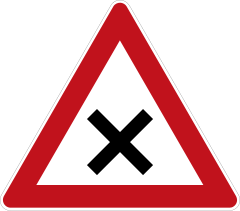
Rechts-vor-links is the default right-of-way rule in Germany. At any intersection that has NO traffic signs, NO traffic lights, and NO police officer directing traffic, the vehicle approaching from your right has priority. You must yield to them before you proceed. This applies regardless of road size — a narrow residential street and a wider street have equal standing unless signs say otherwise.
The rule is surprisingly simple in isolation, but in practice it generates the most exam errors because students fail to recognize WHEN it applies. The key test is: look for the absence of regulation. If you approach an intersection and see no sign 205 (yield), no sign 206 (stop), no sign 301 (priority), no sign 306 (priority road), and no traffic light, then rechts-vor-links is in effect.
A critical scenario: you approach a four-way intersection with three other vehicles arriving simultaneously from the left, right, and opposite direction. Step-by-step: (1) You must yield to the vehicle on your right. (2) That vehicle must yield to the vehicle on ITS right (the one opposite you). (3) The vehicle on your left must yield to you. In theory, if all four arrive at exactly the same time, no one can move — this is the "deadlock" scenario taught in driving school. In practice, one driver cautiously proceeds or signals, and the knot resolves.
Another common scenario: you are on a straight road and a small side street joins from the right. There are no signs. The vehicle from the small side street has right of way over you, even though your road feels "bigger." Road width does not determine priority — only signs and rules do. Many students get this wrong because they assume the wider road automatically has priority.
Important exception: rechts-vor-links does NOT apply when one road is clearly a field path, forest path, or dirt track (Feld- oder Waldweg) joining a paved road. Vehicles leaving such unpaved paths must yield to traffic on the paved road. However, if both roads are paved — even if one is much narrower — rechts-vor-links applies fully.
Tips
- At an unregulated intersection, always slow down and look right FIRST — the vehicle from the right has priority over you.
- Count the regulation elements: no signs + no lights + no officer = rechts-vor-links. If even ONE regulation element is present, rechts-vor-links is overridden.
- In residential zones (Spielstraße / verkehrsberuhigter Bereich), rechts-vor-links applies at every junction unless otherwise signed.
Common Mistakes
- Assuming a wider road automatically has priority — it does not. Only signs grant priority.
- Forgetting that rechts-vor-links applies when traffic lights are OUT OF SERVICE (showing no light at all or flashing yellow).
- Ignoring vehicles from the right at T-intersections — the rule applies at T-junctions too, not only at four-way crossroads.
Exceptions: When Rechts-vor-links Does NOT Apply
There are several important situations where rechts-vor-links is overridden. Understanding these exceptions is just as critical as understanding the base rule.
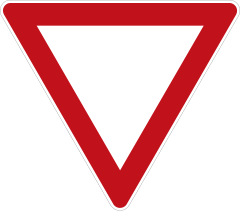
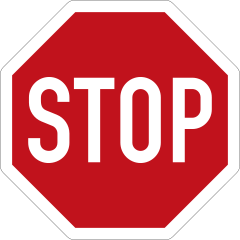
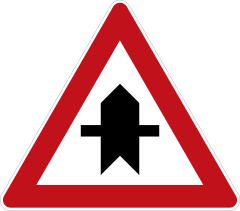
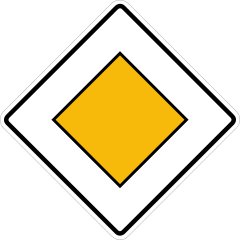
First exception — traffic signs: If any right-of-way sign is present (sign 205 "Yield," sign 206 "Stop," sign 301 "Priority at next intersection," or sign 306 "Priority road"), the signs govern priority, not rechts-vor-links. Sign 205 (inverted triangle) means you yield to ALL cross traffic. Sign 206 (octagonal stop sign) means you must come to a complete stop AND yield. Sign 301 (yellow diamond with white border, shown once) gives you priority at the NEXT intersection only. Sign 306 (same diamond, used repeatedly) marks a continuous priority road.
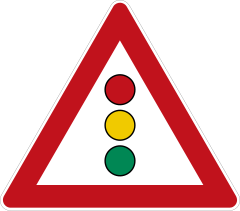
Second exception — traffic lights: When a traffic light is operational and showing colors (green, yellow, red), it overrides all signs and rechts-vor-links. However, if the traffic light is switched off entirely or is flashing yellow only, the underlying sign-based rules (or rechts-vor-links if no signs exist) take over. This catches many students: flashing yellow traffic light means "proceed with caution" and check for signs or apply rechts-vor-links.
Third exception — police officer: A police officer directing traffic overrides EVERYTHING — signs, lights, and rechts-vor-links. The officer's signals are the highest authority.
Fourth exception — leaving private property, parking lots, gas stations, or garages: If you are pulling out of a driveway, parking lot, gas station, or any private area onto a public road, you must yield to ALL traffic on the public road — regardless of direction. This is codified in StVO section 10. There is no rechts-vor-links between a private exit and a public road.
Fifth exception — vehicles on unpaved field or forest paths joining a paved road must yield to all paved-road traffic. The logic is that such paths are not considered equal roads.
Sixth exception — pedestrian zones and special traffic calming areas may have their own posted rules at entry and exit that override the default.
Tips
- The hierarchy of authority is: police officer > traffic light > traffic signs > rechts-vor-links. Memorize this order.
- A flashing yellow traffic light does NOT mean 'go.' It means 'caution — determine right of way from signs or rechts-vor-links.'
- When exiting ANY private property (driveway, parking lot, gas station), you yield to everyone — pedestrians, cyclists, and vehicles in both directions.
Common Mistakes
- Thinking a broken traffic light means you can just drive through — you must fall back to signs or rechts-vor-links.
- Confusing sign 301 (priority at the NEXT intersection only) with sign 306 (continuous priority road). Sign 301 is a one-time grant; sign 306 persists until cancelled by sign 307.
- Forgetting that leaving a gas station or parking lot means you yield to everyone, even if a vehicle approaches from the left.
Vorfahrtstraße: Priority Roads and Their Signs
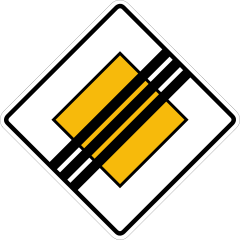
A Vorfahrtstraße (priority road) is marked by sign 306 — a yellow diamond with a white border. This sign tells you that you are on a road with continuous priority over all side streets. Vehicles on side streets approaching your road must yield to you. This priority continues until cancelled by sign 307 (the same diamond with diagonal black lines through it, meaning "End of priority road").
Sign 306 is often combined with supplementary signs showing the course of the priority road. For example, a white rectangular sign below 306 may show a thick black line curving to the right with thinner lines branching off. This means the priority road curves right, and the straight-ahead direction is a side street. In this case, vehicles on the priority road (following the curve) have priority over vehicles on the branching streets. Students must read these combination signs carefully.
When you are on a side street approaching a priority road, you will see sign 205 (yield — inverted white triangle with red border) or sign 206 (stop — red octagon). Sign 205 means: slow down, yield to traffic on the priority road, and proceed only when safe. You do not have to stop completely if the way is clearly free. Sign 206 means: come to a COMPLETE stop at the stop line (or at the edge of the priority road if no line), look both ways, and proceed only when safe. Rolling through a stop sign is a violation.
A subtle but frequently tested scenario: you are on the priority road (sign 306) and the supplementary sign shows the priority road turning left. You want to go straight. In this case, going straight takes you OFF the priority road — you must now yield to traffic that is following the priority road from the other direction. Many students assume they keep priority because they were on the priority road, but priority follows the marked course, not your personal direction.
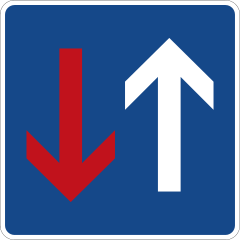
Sign 308 is the "Vorrang vor dem Gegenverkehr" sign — a blue rectangle with a large white arrow (your direction) and a small red arrow (oncoming). This means you have priority over oncoming traffic in a narrow section. Its counterpart, sign 208, shows a large red arrow (you) and a small white arrow (oncoming), meaning you must yield to oncoming traffic.
Tips
- Always read the supplementary sign below sign 306 — it shows the exact course of the priority road at the upcoming intersection.
- Sign 301 gives priority at ONE intersection only. Sign 306 gives continuous priority until cancelled by 307.
- At a stop sign (206), you must make a full stop even if you can clearly see no traffic is coming. The exam tests this explicitly.
Common Mistakes
- Assuming you keep priority when leaving the marked course of a priority road — you only have priority while following the thick line on the supplementary sign.
- Rolling through a stop sign (206) instead of making a complete stop — this is both an exam error and a real-world fine.
- Confusing sign 308 (you have priority over oncoming) with sign 208 (you must yield to oncoming). Check the arrow colors: large white arrow = you have priority.
Traffic Lights: Colors, Arrows, and Special Signals
German traffic lights follow a specific sequence: red, red+yellow together, green, yellow, red. The red+yellow phase (both lit simultaneously) signals that green is about to come — prepare to go, but do NOT drive yet. Yellow alone means the light is about to turn red — stop if you can safely do so. If you are so close that stopping would be dangerous (emergency braking), you may proceed through a yellow light, but this is the exception, not the rule.
Green means go, but with conditions. You must still yield to pedestrians already in the crosswalk when you turn, and you must not enter the intersection if the exit is blocked (do not block the Kreuzung). A common exam question: "The light is green, but traffic is backed up into the intersection. What do you do?" Answer: wait before the intersection even though the light is green. Blocking an intersection is a violation.
Green arrow signals (Grünpfeil): a green arrow displayed as part of the traffic light (illuminated) allows you to turn in that direction even when the main signal is red for other directions. This is a filtered turn — you have a dedicated phase and may proceed. Do not confuse this with the Grünpfeilschild (green arrow sign, a small metal plate with a green arrow on black background, mounted next to the red light). The Grünpfeilschild allows you to turn right on red AFTER stopping completely and yielding to all cross traffic and pedestrians. You MUST stop first. This is one of the most common exam questions.
Flashing yellow: a traffic light flashing only yellow (no red, no green) means the signal is in standby mode. You must proceed with caution and determine right of way based on traffic signs at the intersection or, if none exist, by rechts-vor-links.
Arrow traffic lights (Richtungspfeile): some intersections have separate signals for each direction — a red arrow, yellow arrow, and green arrow. These control only the direction the arrow points. If the straight-ahead signal is red but the left-turn arrow is green, you may turn left but not go straight.
Bus-only signals (white bar signals): these are the horizontal/vertical/diagonal white bar signals seen near bus stops and tram lines. They do not apply to regular vehicles — ignore them as a car driver. However, know that when a bus has a white bar signal allowing it to proceed, you must be aware it may move.
Tips
- Red + yellow together = 'get ready' but do NOT move yet. Wait for green.
- The Grünpfeilschild (small metal sign) requires a full stop before turning right on red. The illuminated green arrow does NOT require stopping — it is a regular green phase for that direction.
- Never enter an intersection on green if your exit is blocked. Blocking the Kreuzung is a separate violation.
Common Mistakes
- Driving on red+yellow (treating it like green) — this is running a red light.
- Confusing the illuminated green arrow (part of the traffic light, no stop needed) with the Grünpfeilschild (metal plate sign, must stop first).
- Assuming flashing yellow means 'go freely' — it means caution and check for other right-of-way rules.
Police Officer Hand Signals (Polizeibeamte)
A police officer directing traffic has the highest authority — overriding traffic lights, signs, and all other rules. You must know three key positions and what they mean for your direction of travel.
Position 1 — Officer facing you (chest or back toward you): This means STOP. Whether you see the officer's face or the officer's back, if the officer's body is oriented toward you, you may not proceed. Think of the officer's outstretched arms as a barrier wall — if the wall faces you, you are blocked.
Position 2 — Officer showing their side to you (you see their shoulder): This means you may GO. The officer's arms may be extended sideways or at their sides. If you see the officer's left or right shoulder, traffic in your direction is released. You may proceed straight or turn right. To turn left, you would pass in front of the officer.
Position 3 — Officer raises one arm straight up: This is equivalent to YELLOW on a traffic light. It means "Attention — prepare to stop or prepare to go." If you were already moving, bring your vehicle to a stop safely. If you were stopped, get ready for the next signal. This signal also serves as a general "attention" command when the officer is transitioning between directions.
A detailed scenario: you approach an intersection controlled by a police officer. The officer is standing in the middle, facing to your left (their right shoulder is toward you). Since you see their side, you may proceed. Now the officer raises their arm — you prepare to stop. The officer then turns to face you directly — you must stop. Eventually, the officer turns so their side faces you again — you may go.
Important nuance: the officer's signals apply even if a traffic light behind them shows a different color. If the light is green but the officer faces you (stop signal), you MUST stop. The officer always wins.
Another exam scenario: you are at an intersection with a police officer and a traffic light. The light shows red, but the officer has their side to you (go signal). What do you do? You follow the officer and proceed. The exam tests whether students understand the hierarchy: officer > lights > signs > rechts-vor-links.
Tips
- Chest or back facing you = STOP. Side (shoulder) facing you = GO. Arm up = YELLOW/prepare.
- If both a police officer and a traffic light are present, ALWAYS follow the officer. Ignore the light.
- Practice by imagining the officer as a wall — if the wall faces you, you cannot pass through it.
Common Mistakes
- Confusing 'officer facing you' with 'officer looking at you' — it is about body orientation, not eye contact.
- Following the traffic light instead of the officer when both are present — the officer ALWAYS overrides.
- Forgetting that the raised arm means yellow (prepare), not stop immediately with an emergency brake.
Roundabouts (Kreisverkehr)
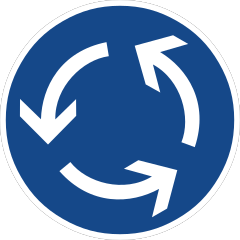
Roundabouts in Germany are marked by sign 215 (blue circle with three white arrows forming a circle) combined with sign 205 (yield) at entry. The basic rules are straightforward but often tested.
Rule 1: Vehicles already inside the roundabout have priority. You must yield when entering. This is NOT rechts-vor-links even though traffic inside the circle comes from your left — the yield sign (205) at the entry explicitly overrides rechts-vor-links. If sign 215 is combined with 205, yield to traffic in the circle. Period.
Rule 2: Do NOT signal when entering the roundabout. Many students instinctively activate their right turn signal when entering the circle from the right side, but this is wrong. You only signal when EXITING the roundabout. As you approach your desired exit, activate your right turn signal to inform others you are leaving the circle.
Rule 3: Stay in your lane within the roundabout. In multi-lane roundabouts, choose the appropriate lane before entering. Generally, the right lane is for the first or second exit, and the left (inner) lane is for exits further around the circle. When exiting from the inner lane, check your right mirror and blind spot for vehicles in the outer lane.
Rule 4: Pedestrians at roundabout exits have the right of way if a crosswalk is present. When exiting the roundabout, watch for pedestrians at the zebra crossing that typically exists at each exit.
A typical exam scenario: you approach a roundabout with sign 215 and 205. A vehicle is already circling inside. Another vehicle approaches the roundabout from the road to your left. Who goes first? (1) The vehicle inside the circle goes first — it has priority. (2) You and the vehicle from the left both must yield to circle traffic. (3) Between you and the vehicle from the left, there is no rechts-vor-links because both of you are governed by yield signs at your respective entries — you each independently wait for a gap in circle traffic.
Important: some older or smaller roundabouts may not have signs 215 and 205. In that rare case, rechts-vor-links would technically apply, meaning vehicles entering would have priority over those in the circle (because they come from the right). This is unusual and typically only found in very small, unmarked traffic circles. The exam may test this edge case.
Tips
- Do NOT signal when entering a roundabout — only signal RIGHT when exiting.
- Always look for pedestrian crosswalks at roundabout exits. Pedestrians on crosswalks have priority.
- In a multi-lane roundabout, choose your lane before entering. Right lane for nearby exits, left lane for far exits.
Common Mistakes
- Signaling left when entering the roundabout — this is wrong. No signal on entry.
- Applying rechts-vor-links inside a signed roundabout — the yield sign at entry overrides it.
- Forgetting to signal right when leaving the roundabout — other drivers and pedestrians rely on your signal.
Right of Way When Turning (Abbiegen)
Turning at intersections introduces additional right-of-way rules beyond the basic priority of the road. Even if you have the right of way (green light, priority road), turning creates obligations toward other road users.
Rule 1 — Turning vehicles must yield to oncoming traffic going straight. If you are turning left at an intersection and an oncoming vehicle is going straight, the oncoming vehicle has priority. This applies even if you have a green light — green means you may enter the intersection, but you must still yield to oncoming straight traffic when turning left. You pull into the intersection, wait for a gap in oncoming traffic, and then complete your turn.
Rule 2 — Turning vehicles must yield to pedestrians and cyclists crossing the street they are turning into. This is codified in StVO section 9. When you turn right, yield to pedestrians on the crosswalk of the street you are entering. When you turn left, yield to pedestrians and cyclists on BOTH the street you are leaving and the street you are entering. This catches many students: even with a green light, you must let pedestrians finish crossing.
Rule 3 — Two left-turning vehicles meeting from opposite directions. The standard rule in Germany is that you pass BEHIND each other (rechts-aneinander-vorbei), meaning you keep the intersection center to your left. However, if the intersection layout or road markings direct you to pass in FRONT of each other, follow the markings. The exam tests whether you know the default (pass behind each other) and whether you can recognize when markings override it.
Rule 4 — When leaving a priority road by turning, you must signal your turn AND yield to oncoming traffic on the priority road. The supplementary sign below sign 306 shows the priority road's course. If the priority road curves and you want to leave it by going straight, you are effectively leaving the priority road — you must yield to traffic following the priority road's marked course.
Scenario: you are on a priority road (sign 306) that curves to the right, and you want to turn left off the priority road. You must: (1) signal left, (2) yield to oncoming traffic that is following the priority road from the opposite direction, and (3) yield to oncoming traffic going straight because turning left means you cross their path.
Tips
- Left turn = yield to oncoming straight traffic, even on green. Pull into the intersection and wait for a gap.
- When turning, ALWAYS check for pedestrians and cyclists crossing the street you are turning into — they have priority.
- Two vehicles turning left toward each other: default is pass BEHIND each other (right side to right side).
Common Mistakes
- Assuming a green light means you can turn left without yielding to oncoming traffic — green is permission to enter the intersection, not a blanket right of way.
- Forgetting pedestrians on the road you are turning INTO — your focus is on oncoming cars, but a pedestrian is crossing the target street.
- Not signaling when leaving a priority road — other drivers need to know you are departing the priority road's course.
Special Right-of-Way Situations
Several special situations create right-of-way obligations that do not fit neatly into the categories above. These are frequently tested on the exam.
Leaving private property (StVO section 10): When you drive out of a property entrance, driveway, garage, parking lot, gas station, or any other private area onto a public road, you must yield to ALL traffic — vehicles, cyclists, and pedestrians in both directions. This is not rechts-vor-links. You have an absolute duty to yield. Similarly, when pulling away from the curb after parking, you must yield to flowing traffic and signal your intention.
Merging from an acceleration lane (Beschleunigungsstreifen) onto a highway: Traffic on the main carriageway has priority. You must adjust your speed on the acceleration lane and merge into a gap. Main-carriageway traffic is encouraged but NOT required to make room for you. In practice, vehicles often move to the left lane to let you merge, but you cannot rely on this — the duty to yield is yours.
Tram/streetcar priority: Trams (Straßenbahnen) often have special right-of-way rules. When a tram is at a stop and passengers are boarding or alighting, you must wait. You may only pass a stopped tram at walking speed (Schrittgeschwindigkeit, roughly 4-7 km/h) if there is enough room and the doors are on the opposite side. If passengers must cross the road to reach the sidewalk, you must stop completely. At intersections, trams frequently have priority even against rechts-vor-links — always check for tram-specific signals and signs.
Emergency vehicles (Einsatzfahrzeuge): When an emergency vehicle approaches with blue flashing lights AND siren (Martinshorn), you must immediately make way. On multi-lane roads, this means forming a Rettungsgasse (rescue lane). The emergency vehicle has priority over everyone. On a two-lane road, move to the right and stop if necessary. You may carefully drive through a red light to make room for an emergency vehicle, but only if you can do so safely.
Funeral processions and military convoys: Closed formations (geschlossene Verbände) have special right-of-way. You must not cut through a funeral procession or an organized convoy. Wait for the entire group to pass.
Tips
- Leaving ANY non-public area (driveway, parking lot, gas station) = yield to ALL traffic. No exceptions.
- Trams have near-absolute priority in most situations. When in doubt, yield to the tram.
- Emergency vehicles with lights AND siren = make way immediately. Lights alone (without siren) do not grant the same absolute priority.
Common Mistakes
- Thinking you have rechts-vor-links when exiting a parking lot onto a road from the right side — you do not. Leaving private property = yield.
- Assuming main-carriageway traffic MUST let you merge from the acceleration lane — they have priority; you must find a gap.
- Passing a stopped tram at normal speed — you must slow to walking speed or stop entirely if passengers are crossing.
Key Rules
Rechts-vor-links applies at unregulated intersections (no signs, no lights, no officer).
Why: It provides a universal default rule so that every intersection has a deterministic right-of-way order, even without signage.
Example: You approach a residential intersection with no signs. A car approaches from your right at the same time. You must stop and let the car from the right proceed first.
Penalty: Failure to yield right of way: 25 EUR fine. If it causes an accident: 100 EUR + 1 point in Flensburg.
A police officer's signals override traffic lights, signs, and all other rules.
Why: Officers can adapt to situations that static systems cannot (accidents, construction, special events).
Example: The traffic light is red, but the officer has their side to you. You follow the officer and proceed through the red light.
At a stop sign (sign 206), you must come to a complete stop — even if the way is clear.
Why: The complete stop ensures the driver actively checks all directions at a high-risk intersection. Rolling through removes this safety check.
Example: You approach sign 206. No traffic is visible in any direction. You must still bring your vehicle to a full stop at the stop line before proceeding.
Penalty: Running a stop sign: 70 EUR + 1 point. If endangering others: 100 EUR + 1 point.
When turning, you must yield to pedestrians and cyclists crossing the street you are turning into.
Why: Pedestrians and cyclists on the cross street are going straight from their perspective. The turning driver is entering their path and must yield.
Example: You have a green light and turn right. A pedestrian is crossing the street you are turning into on a green pedestrian signal. You must wait for the pedestrian to finish crossing.
Penalty: Failure to yield to pedestrians when turning: 70 EUR + 1 point. If causing danger: 100 EUR + 1 point.
Vehicles inside a roundabout (with signs 215 + 205) have priority over entering vehicles.
Why: If entering vehicles had priority, the roundabout would gridlock because circle traffic would constantly be stopped by new entrants.
Example: You arrive at a roundabout with yield sign 205. Two cars are already circling inside. You wait at the entry until both have passed, then enter when a gap appears.
Penalty: Failure to yield when entering a roundabout: 25 EUR. With accident: 100 EUR + 1 point.
Related Traffic Signs
Video Resources
Vorfahrt und Vorrang einfach erklaert (Right of Way Explained)
Comprehensive overview of all right-of-way rules in Germany with animated intersection scenarios covering rechts-vor-links, priority roads, and traffic lights.
Polizist regelt den Verkehr - Handzeichen verstehen
Visual guide to police officer hand signals at intersections, showing all three positions (stop, go, prepare) from the driver's perspective with real-world footage.