8Speed and Distance
Geschwindigkeit, Abstand
Master the speed limits, distance formulas, and braking calculations that appear on nearly every German driving theory exam. This lesson covers default speed limits, the critical formulas for reaction distance, braking distance, stopping distance, and following distance, as well as the visibility rule, weather adjustments, and Autobahn-specific rules.
Default Speed Limits in Germany
Germany has three default speed environments, each with its own baseline limit. Knowing these defaults is fundamental because they apply whenever no other sign modifies them.
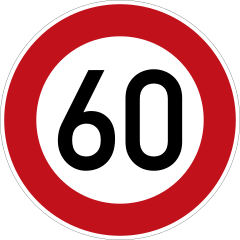
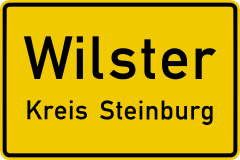
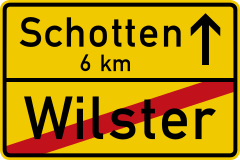
Inside built-up areas (innerorts): the default speed limit is 50 km/h. This applies from the moment you pass the yellow town name sign (sign 310, Ortstafel) until you pass the corresponding end-of-town sign (sign 311, with a red diagonal line through the town name). Within this zone, 50 km/h is the maximum unless a different speed limit sign (sign 274) posts a lower limit (e.g., 30 km/h zones near schools) or, in rare cases, a higher one. Even without any posted sign, 50 km/h is the law the instant you are inside a built-up area.
Outside built-up areas (außerorts): the default speed limit for cars is 100 km/h on regular roads (Landstraßen). This applies on any road outside a town that is NOT an Autobahn or Autobahnähnliche Straße (highway-like road). Trucks and vehicles with trailers have lower limits (80 km/h for trucks over 7.5 tonnes). The 100 km/h limit applies until you see a different speed limit sign or re-enter a built-up area.
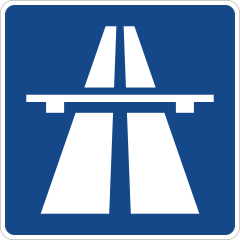
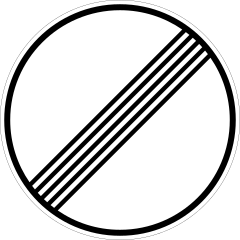
Autobahn: there is NO general speed limit on the Autobahn — only a recommended speed (Richtgeschwindigkeit) of 130 km/h. This means driving faster than 130 km/h is legal on unrestricted sections, BUT if you are involved in an accident while exceeding 130 km/h, you bear partial liability even if the other driver caused the accident. Insurance companies can reduce payouts. Many Autobahn sections DO have posted speed limits (100, 120, or other values), especially near cities, construction zones, and interchanges — these are mandatory.
Entering and leaving built-up areas: the transition is marked by sign 310 (start, yellow town sign) and sign 311 (end, town sign with red line). The moment you pass sign 310, the speed limit drops to 50 km/h immediately — not "soon" or "within 100m," but at the sign itself. The moment you pass sign 311, the outside-of-town limit of 100 km/h applies (unless another sign says otherwise). This is frequently tested.
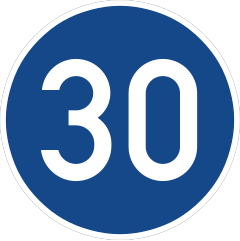
Special zones: 30 km/h zones (Tempo-30-Zone, sign 274.1) are common in residential areas and near schools. They apply to the entire zone until cancelled by sign 274.2. Spielstraßen (traffic-calmed areas, sign 325.1) require walking speed (Schrittgeschwindigkeit, roughly 4-7 km/h). On roads marked with sign 275 (minimum speed), you must drive at least the posted speed — if your vehicle cannot, you may not use that road.
Tips
- 50 inside town (sign 310), 100 outside town, 130 recommended on Autobahn. These three numbers are the foundation.
- The 50 km/h limit begins the INSTANT you pass the town sign — not 100m later. Cameras are often placed right after the sign.
- Driving above 130 km/h on an unrestricted Autobahn is legal but creates partial liability if you have an accident.
Common Mistakes
- Assuming the Autobahn has no speed limit everywhere — many sections have mandatory posted limits.
- Gradually slowing to 50 km/h after passing the town sign — you must be at 50 km/h AT the sign.
- Thinking the 100 km/h outside-town limit applies to all vehicles — trucks over 7.5t are limited to 80 km/h.
Reaction Distance (Reaktionsweg)
Reaction distance is the distance your vehicle travels between the moment you see a hazard and the moment your foot actually presses the brake pedal. During this time — typically about one second for an alert driver — the car is still moving at full speed with no braking force applied.
The formula:
Reaction distance (meters) = (speed in km/h / 10) x 3
This formula assumes a reaction time of approximately 1 second. It gives the distance covered in that one second at the given speed.
Examples at common speeds: - 50 km/h: (50 / 10) x 3 = 5 x 3 = 15 meters - 80 km/h: (80 / 10) x 3 = 8 x 3 = 24 meters - 100 km/h: (100 / 10) x 3 = 10 x 3 = 30 meters - 130 km/h: (130 / 10) x 3 = 13 x 3 = 39 meters
At 50 km/h in a city, you travel 15 meters before you even begin braking. That is roughly 3-4 car lengths. At 130 km/h on the Autobahn, it is 39 meters — almost half a football field — before any braking begins.
Factors that increase reaction time (and therefore reaction distance): fatigue, distraction (especially using a phone), alcohol, drugs, unfamiliar roads, unexpected hazards, and poor visibility. If your reaction time doubles to 2 seconds, the reaction distance also doubles. At 100 km/h, a distracted driver has a reaction distance of 60 meters instead of 30.
The exam frequently presents questions like: "You are driving at 100 km/h. What is your reaction distance?" Apply the formula mechanically: (100 / 10) x 3 = 30 meters. The formula is easy to memorize: divide speed by 10, multiply by 3. Practice it until it is automatic.
One crucial insight: reaction distance is linear with speed. Double the speed = double the reaction distance. This is different from braking distance, which grows quadratically. Understanding this distinction is key for the exam.
Tips
- Reaction distance formula: (speed / 10) x 3. At 100 km/h, that is 30 meters traveled before you even touch the brake.
- Reaction distance grows linearly with speed — double the speed means double the distance. Braking distance is different (see next section).
- Fatigue, distraction, or alcohol can double your reaction time, which doubles the reaction distance.
Common Mistakes
- Confusing reaction distance with braking distance or stopping distance — reaction distance is ONLY the distance before braking begins.
- Forgetting to multiply by 3 in the formula — (speed / 10) alone gives the wrong answer.
- Underestimating how far 15 meters is at 50 km/h — it is longer than many pedestrian crosswalks.
Braking Distance: Normal and Emergency
Braking distance is the distance your vehicle travels from the moment you begin braking to the moment you come to a complete stop. Unlike reaction distance, braking distance grows quadratically — doubling your speed QUADRUPLES your braking distance.
Normal braking distance formula:
Braking distance (meters) = (speed in km/h / 10)²
This gives the distance under normal, controlled braking on a dry road.
Examples: - 30 km/h: (30 / 10)² = 3² = 9 meters - 50 km/h: (50 / 10)² = 5² = 25 meters - 80 km/h: (80 / 10)² = 8² = 64 meters - 100 km/h: (100 / 10)² = 10² = 100 meters - 130 km/h: (130 / 10)² = 13² = 169 meters
Notice the quadratic growth: at 50 km/h the braking distance is 25m, but at 100 km/h (double the speed), it is 100m (four times as much, not double). This is why speed kills — the energy that must be absorbed during braking increases with the square of speed.
Emergency braking distance formula:
Emergency braking distance (meters) = (speed in km/h / 10)² / 2
Emergency braking means applying maximum force to the brake pedal. Modern cars with ABS (anti-lock braking systems) allow you to brake at maximum force without the wheels locking. The emergency braking distance is roughly HALF the normal braking distance.
Examples: - 50 km/h: (50 / 10)² / 2 = 25 / 2 = 12.5 meters - 100 km/h: (100 / 10)² / 2 = 100 / 2 = 50 meters - 130 km/h: (130 / 10)² / 2 = 169 / 2 = 84.5 meters
CRITICAL factors that INCREASE braking distance: wet roads (multiply by approximately 2), icy roads (multiply by approximately 5), worn tires, worn brake pads, downhill gradient, heavy vehicle load. The formulas give ideal dry-road conditions. On a wet road at 100 km/h, normal braking distance becomes roughly 200 meters instead of 100.
The exam will ask you to calculate braking distances at specific speeds. Memorize the formula pattern: divide by 10, square the result. For emergency braking, divide that result by 2. Practice until you can do this in your head in seconds.
Tips
- Normal braking: (speed / 10) squared. Emergency braking: (speed / 10) squared, divided by 2.
- Braking distance grows with the SQUARE of speed. Doubling speed = 4x braking distance. This is the single most important physics concept for driving safety.
- Wet roads roughly DOUBLE braking distance. Ice can multiply it by 5. Adjust speed accordingly.
Common Mistakes
- Calculating braking distance linearly instead of quadratically — at 100 km/h it is 100m, NOT 50m.
- Forgetting that emergency braking is half of normal braking distance, not a third or a quarter.
- Assuming the formulas account for wet or icy conditions — they are for dry roads only. Multiply for adverse conditions.
Stopping Distance = Reaction + Braking
Stopping distance is the TOTAL distance from the moment you see a hazard to the moment your vehicle comes to a complete stop. It combines both reaction distance and braking distance.
Stopping distance formula:
Stopping distance = Reaction distance + Braking distance Stopping distance = [(speed / 10) x 3] + [(speed / 10)²]
For emergency stopping:
Emergency stopping distance = [(speed / 10) x 3] + [(speed / 10)² / 2]
Let us calculate the full stopping distance at several common exam speeds:
At 50 km/h (normal braking): - Reaction: (50/10) x 3 = 15m - Braking: (50/10)² = 25m - Total stopping distance: 15 + 25 = 40 meters
At 50 km/h (emergency braking): - Reaction: 15m (same — you still need time to react) - Braking: 25 / 2 = 12.5m - Total: 15 + 12.5 = 27.5 meters
At 100 km/h (normal braking): - Reaction: (100/10) x 3 = 30m - Braking: (100/10)² = 100m - Total: 30 + 100 = 130 meters
At 100 km/h (emergency braking): - Reaction: 30m - Braking: 100 / 2 = 50m - Total: 30 + 50 = 80 meters
At 130 km/h (normal braking): - Reaction: (130/10) x 3 = 39m - Braking: (130/10)² = 169m - Total: 39 + 169 = 208 meters
These numbers are sobering. At 100 km/h with normal braking, you need 130 meters to stop — longer than a football field. Even with emergency braking, you need 80 meters. And these are ideal, dry-road conditions.
The exam will present scenarios like: "A child runs into the road 40 meters ahead. You are driving 50 km/h. Can you stop in time?" With normal braking, your stopping distance is 40m — you would hit the child exactly at the point they are standing. With emergency braking, 27.5m — you stop in time, but barely. This is why speed limits in residential areas are set at 30 km/h near schools: at 30 km/h, normal stopping distance is (9 + 9) = 18 meters, and emergency is (9 + 4.5) = 13.5 meters.
Key insight for the exam: reaction distance is ALWAYS added, even in emergency stops. You cannot react faster just because the situation is more urgent. Emergency braking only halves the BRAKING portion.
Tips
- Stopping distance = reaction distance + braking distance. Always add both — you cannot skip the reaction phase.
- Emergency braking halves the braking distance but does NOT reduce the reaction distance.
- At 50 km/h, normal stopping = 40m. At 100 km/h, it is 130m. Speed increases stopping distance dramatically because braking distance is quadratic.
Common Mistakes
- Forgetting to add reaction distance in emergency braking — reaction time does not disappear just because you brake harder.
- Calculating stopping distance using only the braking formula and omitting the reaction component.
- Not recognizing that doubling speed MORE than doubles the stopping distance (because the braking portion quadruples while reaction portion doubles).
Following Distance (Sicherheitsabstand)
Following distance is the gap you must maintain between your vehicle and the vehicle ahead. This gap gives you time and space to react if the vehicle ahead brakes suddenly.
The rule of thumb formula:
Following distance (meters) = speed in km/h / 2
At 50 km/h: 50 / 2 = 25 meters (minimum following distance) At 100 km/h: 100 / 2 = 50 meters (minimum following distance) At 130 km/h: 130 / 2 = 65 meters (minimum following distance)
On the Autobahn, a practical way to measure following distance is using the distance markers. White posts with reflectors are placed every 50 meters along the Autobahn. At 100 km/h, you need at least one full gap between two posts (50m). At 130 km/h, you need a little more than one gap. If the vehicle ahead passes a post and you reach it before two seconds have elapsed, you are too close.
The two-second rule: as a mental check, pick a fixed point (a sign, a bridge, a road marking). When the vehicle ahead passes it, start counting "one-thousand-one, one-thousand-two." If you reach the point before finishing "one-thousand-two," you are following too closely. At higher speeds, use three seconds or more.
INCREASED following distance is required in these conditions: wet roads (multiply by 1.5-2x), icy or snowy roads (multiply by 3-5x), fog (significantly more), when following trucks that spray water, when following motorcycles (they can stop faster than cars), and at night when visibility is reduced.
A critical exam scenario: on the Autobahn at 130 km/h, what is the minimum following distance? Answer: 130 / 2 = 65 meters. What happens if the vehicle ahead brakes and you are only 30 meters behind? Your reaction distance alone at 130 km/h is 39 meters — you would already hit the vehicle before you even start braking.
Tailgating (zu dichtes Auffahren) is one of the most commonly fined violations in Germany, especially on the Autobahn. Police use bridge-mounted cameras that photograph vehicles and measure the gap. Fines and penalties escalate sharply with the severity of the violation.
Tips
- Following distance = speed / 2 in meters. At 100 km/h, keep at least 50 meters gap.
- On the Autobahn, use the 50m marker posts to judge your following distance.
- The two-second rule is an easy check: count 'one-thousand-one, one-thousand-two' after the car ahead passes a fixed point.
Common Mistakes
- Following too closely at high speed — at 130 km/h your reaction distance alone (39m) exceeds the gap most tailgaters maintain.
- Not increasing following distance in rain or fog — the standard formula assumes dry roads and good visibility.
- Using car lengths instead of meters to judge distance — most people underestimate how far 50 meters actually is.
The Visibility Rule: See and Be Seen
The visibility rule (Sichtfahrgebot) is one of the most important speed-related rules in German traffic law: you must always drive at a speed that allows you to stop within the distance you can see to be clear.
The simple version: if you can only see 50 meters ahead (due to fog, rain, darkness, curves, or hills), your maximum speed must allow you to stop within 50 meters. This is not a suggestion — it is a legal requirement (StVO section 3).
Applying the formula: if visibility is 50 meters, what is the maximum speed?
You need: stopping distance less than or equal to 50 meters. Stopping distance = (speed/10) x 3 + (speed/10)²
Working backward: At 50 km/h: stopping distance = 15 + 25 = 40m (fits within 50m - OK) At 60 km/h: stopping distance = 18 + 36 = 54m (does NOT fit in 50m - TOO FAST)
So with 50m visibility, the maximum safe speed is approximately 50 km/h.
Practical rule of thumb: 50 meters of visibility corresponds to roughly 50 km/h maximum speed. This is easy to remember and commonly tested on the exam.
Fog: in dense fog, visibility can drop to 20-30 meters or less. At 30m visibility, you should not exceed approximately 30 km/h. Use your fog lights (Nebelschlussleuchte is the rear fog light, only legal when visibility is below 50 meters). Your low beams must be on — high beams in fog reflect off water droplets and make visibility WORSE.
Night driving on unlit roads: your low beams illuminate approximately 50-75 meters ahead. Your high beams illuminate approximately 100-200 meters. Your speed must match this visibility. On a dark country road with low beams only, you should not exceed approximately 60-70 km/h because your stopping distance must fit within the illuminated area.
Curves and hills: on a winding road, you can only see as far as the curve allows. If you see 40 meters of road before it curves out of sight, you need to be able to stop within 40 meters. This is why winding mountain roads demand much lower speeds even if no speed limit is posted.
The visibility rule means you automatically adjust your speed to conditions — no sign needed. The exam tests this with questions like: "It is foggy and you can see 50 meters. What is your maximum speed?" Answer: approximately 50 km/h.
Tips
- 50 meters visibility = maximum 50 km/h. This is the most commonly tested application of the visibility rule.
- In fog, use low beams (NOT high beams, which reflect off fog). Use rear fog lights only below 50m visibility.
- On dark roads, your speed must match your headlight range. Low beams = ~50-75m range = max ~60-70 km/h.
Common Mistakes
- Driving at the posted speed limit in fog instead of adjusting to visibility — the visibility rule overrides posted limits.
- Using high beams in fog — they reflect off water droplets and reduce your visibility further.
- Forgetting that the visibility rule applies to curves and hills, not just weather — if you can only see 40m of road, adjust speed to stop within 40m.
Speed Adjustment for Weather and Road Conditions
Posted speed limits and default limits are maximum speeds under ideal conditions. When conditions deteriorate, you are legally required to reduce speed even if no sign tells you to.
Wet roads (nasse Fahrbahn): water between the tire and road surface reduces grip significantly. Braking distances roughly double on wet roads. At higher speeds, there is a risk of aquaplaning (hydroplaning) — a film of water lifts the tires off the road surface, and you lose all steering and braking control. Aquaplaning typically begins around 80 km/h on standing water, but it depends on tire condition, water depth, and speed. If you feel the steering become light and unresponsive, do NOT brake hard or turn the wheel sharply — ease off the accelerator gently and keep the wheel straight until the tires regain contact.
Snow and ice (Schnee und Eis): braking distances can increase by a factor of 5 or more on ice. At 50 km/h, your normal braking distance of 25m becomes 125m or more on ice. Winter tires (Winterreifen) are mandatory in Germany when conditions require them ("situative Winterreifenpflicht"). They must have a minimum tread depth of 1.6mm by law, but the recommended minimum is 4mm for effective water and snow displacement.
Leaves and road grime in autumn: wet leaves on the road surface are nearly as slippery as ice. Railroad crossings, bridge joints, and road markings also become very slippery when wet.
Strong winds (Seitenwind): crosswinds are especially dangerous on exposed roads (bridges, highway exits from forests into open fields, coastal roads). Sign 117 warns of crosswinds. Reduce speed and hold the steering wheel firmly. Trucks and vehicles with high profiles (vans, vehicles with roof racks) are more affected.
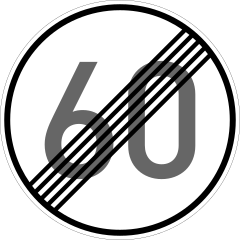
The conditional speed limit sign: some speed limits include a supplementary sign "bei Naesse" (when wet). For example, a sign showing 80 km/h with "bei Naesse" beneath it means the 80 km/h limit ONLY applies when the road is wet. When the road is dry, the normal limit applies (e.g., 100 km/h outside built-up areas). This is a very common exam question.
General legal principle: StVO section 3 paragraph 1 states that you must drive only as fast as you can maintain control of your vehicle, considering road, traffic, visibility, and weather conditions. Even if the posted limit is 100 km/h, driving 100 km/h on an icy road is reckless driving and a violation.
Tips
- Wet roads double braking distance. Ice can multiply it by 5. Reduce speed proactively, not after you start sliding.
- If you feel aquaplaning (light, unresponsive steering), ease off the gas gently. Do NOT brake or turn sharply.
- The 'bei Naesse' supplementary sign means the speed limit applies ONLY when the road is wet — dry roads use the normal limit.
Common Mistakes
- Driving at the posted speed limit on a wet road and braking too late — the posted limit is for ideal conditions.
- Braking hard during aquaplaning — this locks the wheels and removes all control. Let off the gas gently instead.
- Ignoring the 'bei Naesse' condition — the exam specifically tests whether you know this speed limit is conditional.
Autobahn: Speed, Distance, and Special Rules
The Autobahn has unique speed and distance rules that differ from other German roads. Understanding these is critical for both the exam and real-world driving.
Recommended speed (Richtgeschwindigkeit): 130 km/h. This is not a legal limit on unrestricted sections — it is a recommendation. However, exceeding 130 km/h carries a legal consequence: if you are involved in an accident while exceeding the Richtgeschwindigkeit, you share partial liability even if the other driver was at fault. Insurance companies routinely invoke this to reduce payouts. For the exam, know that 130 km/h is "empfohlen" (recommended), not "vorgeschrieben" (mandatory).
Minimum speed: there is no general minimum speed on the Autobahn, but vehicles must be capable of traveling at least 60 km/h to use it. Pedestrians, cyclists, mopeds, and other slow vehicles are prohibited. If road conditions (fog, construction) require driving below 60 km/h, that is allowed — the 60 km/h requirement is about vehicle capability, not actual speed. Sign 275 (blue circle with a number) sets a mandatory minimum speed for specific sections.
Following distance enforcement: on the Autobahn, following distance is aggressively enforced using bridge-mounted cameras (Abstandsmessung). The camera photographs your vehicle and the vehicle ahead simultaneously, measuring the gap. Penalties for tailgating are severe and escalate with how close you are and how fast you are going. At 130 km/h with less than 3/10 of the "speed / 2" following distance (less than about 19.5 meters), you face 400 EUR, 2 points, and a 3-month driving ban.
Right-lane driving requirement (Rechtsfahrgebot): on the Autobahn, you must use the rightmost free lane. The left lane is for overtaking only. After overtaking, you must return to the right lane. Cruising in the left lane while the right lane is free ("Linksfahrer") is a violation. The middle lane of a three-lane Autobahn may be used continuously if the right lane has regular slow traffic (trucks), but you should still move right when possible.
Overtaking on the right (Rechtsüberholen): overtaking on the right is generally prohibited on the Autobahn. Exception: in slow-moving traffic (Stau) or when traffic in the left lane is moving at 60 km/h or less, you may pass on the right at up to 20 km/h faster than the left-lane traffic. Outside of traffic jams, overtaking on the right can result in a fine and points.
Construction zones (Baustellen): Autobahn construction zones have temporary speed limits (typically 60-80 km/h), narrowed lanes, and shifted lane alignments. Respect the posted speed — construction zone speed cameras are very common. The narrow lanes may require extra concentration to stay centered, especially for wider vehicles.
Tips
- 130 km/h on the Autobahn is recommended, not mandatory — but exceeding it creates partial liability in accidents.
- Vehicles must be CAPABLE of 60 km/h to use the Autobahn. Pedestrians, cyclists, and mopeds are prohibited.
- Right lane is the default. Left lane is for overtaking ONLY. After passing, return to the right.
Common Mistakes
- Cruising in the left lane when the right lane is free — this violates the Rechtsfahrgebot (right-lane driving requirement).
- Tailgating on the Autobahn — bridge cameras catch you and fines are severe (up to 400 EUR + 2 points + 3-month ban).
- Overtaking on the right outside of a traffic jam — this is illegal. Wait for the left-lane vehicle to move right, or flash your headlights briefly to signal.
Key Rules
Default speed limits: 50 km/h in built-up areas, 100 km/h outside, 130 km/h recommended on the Autobahn.
Why: These defaults account for the typical hazard density in each environment. Cities have pedestrians and intersections every few meters; rural roads have curves and wildlife; the Autobahn is designed for high-speed travel.
Example: You pass the town sign (sign 310) entering a village. Even though no speed limit sign is posted, the limit is now 50 km/h. You leave the village and pass sign 311 — the limit becomes 100 km/h.
Penalty: Exceeding 50 km/h in town by 21 km/h: 115 EUR + 1 point. By 31 km/h: 260 EUR + 2 points + 1-month ban. By 51+ km/h: 560 EUR + 2 points + 2-month ban.
Stopping distance = reaction distance + braking distance = (speed/10) x 3 + (speed/10) squared.
Why: Drivers must understand total stopping distance to maintain safe following distances and approach hazards at appropriate speeds. The quadratic braking component means small speed increases have outsized effects on stopping distance.
Example: At 100 km/h: reaction distance = 30m, braking distance = 100m, total stopping distance = 130 meters. This means you need more than the length of a football field to stop from 100 km/h under normal braking.
Following distance must be at least half the speedometer reading in meters (speed / 2).
Why: This gap provides enough reaction and braking space if the vehicle ahead stops suddenly. At highway speeds, insufficient following distance is one of the leading causes of rear-end collisions.
Example: At 80 km/h, you must maintain at least 40 meters to the vehicle ahead. On the Autobahn, use the 50m marker posts to verify your gap.
Penalty: Following too closely at 100 km/h with less than 25m gap: 100 EUR + 1 point. Less than 15m gap: 160 EUR + 2 points + 1-month ban.
The visibility rule (Sichtfahrgebot): you must be able to stop within the distance you can see to be clear.
Why: If you cannot see far enough to stop in time, any obstacle beyond your visibility becomes an unavoidable collision. This rule forces speed adaptation to conditions without needing specific signs.
Example: Fog limits visibility to 50 meters. You must drive at a speed where your stopping distance is 50 meters or less — approximately 50 km/h maximum. Even if the road's posted limit is 100 km/h, you must slow to 50 km/h.
Penalty: Driving too fast for conditions: 100 EUR + 1 point (general). If causing an accident: 145 EUR + 2 points + 1-month ban.
On wet roads, braking distance approximately doubles. On ice, it can increase by a factor of 5.
Why: Water and ice reduce tire grip dramatically. The formulas taught in driving school assume dry roads — real-world conditions require multiplying the calculated distances.
Example: At 100 km/h on a wet road: normal braking distance becomes approximately 200m instead of 100m. Total stopping distance becomes approximately 230m. On ice at 50 km/h: braking distance can reach 125m instead of 25m.
Related Traffic Signs
Video Resources
Bremsweg, Reaktionsweg, Anhalteweg - Formeln einfach erklaert
Clear step-by-step walkthrough of all distance formulas for the German driving theory exam: reaction distance, normal braking distance, emergency braking distance, stopping distance, and following distance. Includes practice calculations at multiple speeds.
Autobahn fahren - Geschwindigkeit, Abstand, Rechtsfahrgebot
Comprehensive guide to Autobahn-specific rules including the 130 km/h Richtgeschwindigkeit, following distance enforcement, right-lane driving requirement, and construction zone behavior. Features real dashcam footage.