6Traffic Signs and Road Installations
Verkehrszeichen und Verkehrseinrichtungen
Learn to instantly recognize and correctly interpret every category of German traffic sign. This lesson covers warning signs, prohibition signs, mandatory signs, information signs, supplementary signs, road markings, and traffic light variations. You will learn how to read sign combinations and understand the hierarchy when multiple signs interact.
Sign Categories: Shape and Color Tell You Everything
German traffic signs are designed so that their shape and color immediately communicate their category — even before you read the specific symbol. This system means that even at high speed or in poor visibility, a driver can identify whether a sign is a warning, a prohibition, or an instruction purely from its silhouette and color.
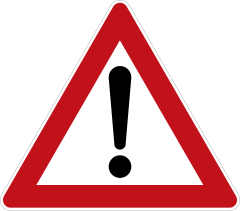
Warning signs (Gefahrzeichen) are upward-pointing triangles with a red border and white background. They alert you to a hazard ahead — a curve, a steep hill, an intersection, construction, animals, etc. Warning signs do not command a specific action, but they tell you to increase attention and usually reduce speed. They are typically placed 150-250 meters before the hazard outside built-up areas and at shorter distances within towns.
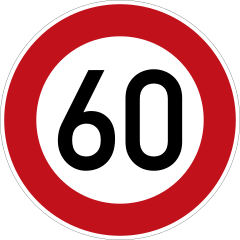
Prohibition signs (Verbotszeichen) are round with a red border and white background. They forbid a specific action: no entry, no overtaking, speed limit, no parking, no stopping, etc. The key visual: a red circle means something is forbidden. Some have a red diagonal bar across the symbol for extra emphasis (like the no-entry sign). Speed limit signs (e.g., sign 274 showing "50") are prohibition signs — they prohibit exceeding the shown speed.
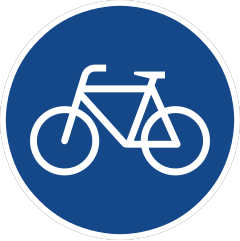
Mandatory signs (Gebotszeichen) are round with a blue background and white symbol. They command a specific action: you MUST follow the direction shown (e.g., turn right, go straight), use a specific lane, or use a specific type of road (e.g., bicycle path). A blue circle with a white arrow pointing right means you MUST turn right. Unlike prohibition signs that say "don't," mandatory signs say "do."
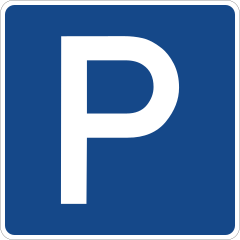
Information signs (Richtzeichen) are typically rectangular or square with a blue background. They provide guidance rather than commands: highway entrances, directions, parking areas, pedestrian zones, dead ends, etc. Sign 314 (white P on blue background) indicates parking is allowed. Sign 330.1 marks the start of an Autobahn.
Supplementary signs (Zusatzzeichen) are small white rectangular plates mounted below a main sign. They modify, restrict, or clarify the main sign's meaning. For example, a time restriction ("Mo-Fr 7-18h"), a distance indicator ("nach 200m"), or an arrow showing which direction the rule applies. Always read the supplementary sign together with the main sign — together they form a single instruction.
Tips
- Triangle = warning (danger ahead). Red circle = prohibition (do not). Blue circle = mandatory (you must). Blue rectangle = information.
- If you cannot see the specific symbol on a sign, its shape alone tells you the category and how to react.
- Supplementary signs (white rectangles below) ALWAYS modify the sign above them — never ignore them.
Common Mistakes
- Confusing prohibition (red circle) with mandatory (blue circle) — red circle means 'forbidden,' blue circle means 'required.'
- Ignoring supplementary signs — a speed limit sign with a supplementary sign saying 'bei Naesse' (when wet) only applies when the road is wet.
- Thinking warning signs require a specific action — they warn of danger but do not prescribe a particular response beyond increased attention.
Warning Signs (Gefahrzeichen) in Detail
Warning signs prepare you for upcoming hazards. While they don't prescribe a specific action, the appropriate response is almost always to reduce speed and increase attention. Here are the most exam-relevant warning signs.
Sign 101 — General hazard (exclamation mark). Used when no specific warning sign exists for the particular danger. A supplementary sign below typically explains the hazard (e.g., "Rauch" for smoke, "Ölspur" for oil spill). When you see sign 101, read the supplementary sign to understand what to expect.
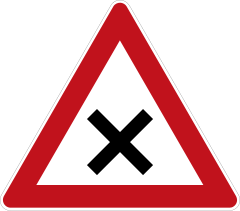
Sign 102 — Intersection or junction with rechts-vor-links. This triangle with an X warns you that the upcoming intersection has no priority regulation — rechts-vor-links applies. It is one of the most critical warning signs because it tells you to prepare to yield to traffic from the right.
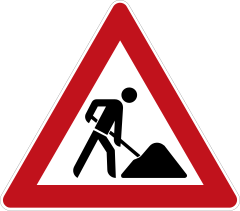
Sign 123 — Construction site (Arbeitsstelle). Warns of roadworks ahead. Expect lane changes, narrowed roads, uneven surfaces, construction vehicles, and workers near the road. Reduce speed significantly. Often combined with supplementary signs showing the length of the construction zone.
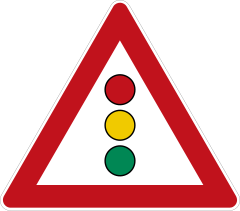
Sign 131 — Light signal ahead (Lichtzeichenanlage). A triangle showing a traffic light symbol. Warns that a traffic light is ahead — important on roads where you might not expect one (e.g., after a curve or on a rural road). Be prepared to stop.
Sign 133 — Pedestrians. Warns that pedestrians frequently cross the road in this area. Reduce speed and watch for people stepping onto the road, especially children near schools.
Sign 136 — Children (two children figures). Warns of an area with many children — near schools, playgrounds, or residential areas. Children are unpredictable; reduce speed dramatically and be ready to stop instantly. This sign demands more caution than the general pedestrian sign.
Warning signs outside built-up areas are placed 150-250m before the hazard. Inside built-up areas, they are placed at shorter distances, often right at the hazard. Some warning signs have supplementary signs showing the exact distance to the hazard (e.g., "in 200m"). The distance matters because it tells you how much time you have to react.
Tips
- Sign 102 (intersection warning) is your cue that rechts-vor-links is coming — start looking right immediately.
- Sign 136 (children) demands you drive so slowly that you can stop INSTANTLY — children dart into the road without warning.
- Outside towns, warning signs appear 150-250m before the hazard. Inside towns, the distance is shorter. Check supplementary signs for exact distance.
Common Mistakes
- Seeing sign 123 (construction) and maintaining speed — construction zones often have temporary speed limits that are heavily enforced.
- Ignoring sign 131 (traffic light ahead) on a road that had no lights for kilometers — you may crest a hill and find a red light immediately.
- Treating sign 136 (children) as a suggestion rather than a command to dramatically reduce speed.
Prohibition Signs and Mandatory Signs
Prohibition signs tell you what you MUST NOT do. They are round with a red border. Understanding the most common ones and their cancellation rules is essential for the exam.
Sign 274 — Speed limit (number inside red circle). The displayed number is the maximum speed in km/h. The limit applies from the sign until: (1) a different speed limit sign appears, (2) a cancellation sign (sign 278) appears, (3) you enter a built-up area (sign 310, which resets to 50 km/h), or (4) you reach an intersection with a priority road sign on the cross street (which may imply the end of the restriction depending on local rules). Important: a speed limit does NOT automatically end at the next intersection unless a new sign or built-up area boundary appears.
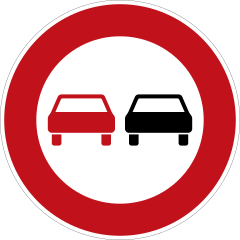
Sign 276 — No overtaking. You must not overtake other motor vehicles (but you may still pass cyclists and slow vehicles under 25 km/h, like tractors). Cancelled by sign 280.
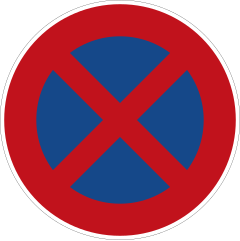
Sign 283 — No stopping (Haltverbot, red circle with red X). You may not stop your vehicle at all — not even briefly. This is stricter than no-parking. Loading/unloading for 3 minutes is not an exception here (that exception only applies to no-parking zones).
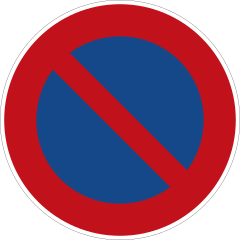
Sign 286 — No parking (Parkverbot, red circle with single red diagonal). You may stop briefly (up to 3 minutes) for loading/unloading or picking up/dropping off passengers, but you may not park (leave the vehicle or stay longer than 3 minutes).
Mandatory signs command what you MUST do. Sign 237 — Bicycle path (white bicycle on blue circle). Cyclists MUST use this path instead of the road. Sign 209-30 — Turn right ahead (white arrow curving right on blue circle). You MUST turn right at the next opportunity. Sign 215 — Roundabout (three white arrows in a circle on blue). You MUST drive around the center island in the direction shown (counterclockwise).
End-of-zone signs: many prohibition signs have matching cancellation signs. Sign 278 cancels a specific speed limit. Sign 282 cancels all restrictions (speed, overtaking). When you see sign 282 (a white circle with five thin black diagonal lines), all previously posted prohibitions end. Inside built-up areas, sign 310 (yellow town name sign) sets the speed limit to 50 km/h and may reset other conditions.
Tips
- Sign 283 (red X) = absolutely no stopping. Sign 286 (single diagonal) = no parking but brief stops OK (up to 3 min).
- Sign 282 (white circle with gray lines) cancels ALL restrictions — speed limits, overtaking bans, everything.
- Speed limits do NOT automatically end at intersections. Look for cancellation signs or town boundary signs.
Common Mistakes
- Confusing sign 283 (no stopping) with sign 286 (no parking) — the difference between one diagonal line and an X is critical.
- Assuming a speed limit ends at every intersection — it does not unless a new sign or town boundary appears.
- Thinking 'no overtaking' means you cannot pass a cyclist — you may still pass cyclists and very slow vehicles.
Reading Sign Combinations and Supplementary Signs
German roads frequently present multiple signs together — a main sign with one or more supplementary signs (Zusatzzeichen) below it. Reading these combinations correctly is a critical exam skill because the supplementary sign changes the meaning of the main sign, sometimes dramatically.
Structure: the main sign is always on top, and supplementary signs are smaller white rectangles mounted directly below. A supplementary sign ONLY applies to the sign directly above it. If two main signs are stacked, each has its own supplementary sign (if any) directly beneath it.
Common supplementary sign patterns:
Time restrictions: "Mo-Fr 7-18h" below a no-parking sign means the parking restriction only applies Monday through Friday, 7 AM to 6 PM. Outside those hours, you may park. "Schulzeit" means the restriction applies during school hours.
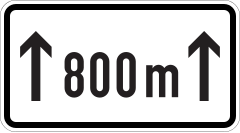
Distance indicators: "auf 2 km" below a warning sign means the hazard extends for 2 km. "nach 200m" means the hazard begins in 200m. "noch 500m" means the restriction continues for another 500m.
Vehicle-type exceptions: a supplementary sign showing a truck silhouette below a prohibition sign means the prohibition applies only to trucks. A supplementary sign with a car silhouette means it applies only to passenger cars.
Direction arrows: black arrows on white supplementary signs show the extent or direction of a restriction. An arrow pointing both left and right below a no-parking sign means no parking in both directions from this point. An arrow pointing left with a "10m" label means the restriction applies for 10m to the left.
Sign 1001-30 (supplementary sign below speed limits): often shows "bei Naesse" (when wet), meaning the speed limit only applies when the road surface is wet. This is a very common exam question — students must recognize that the speed restriction is conditional.
When multiple main signs are posted at one location, read them from top to bottom. Typically, the most restrictive or important sign is on top. For example, at a roundabout entrance you might see sign 215 (roundabout) on top and sign 205 (yield) below it — together they mean: roundabout ahead, yield to traffic inside.
Tips
- Always read the supplementary sign — it can completely change when, where, or to whom the main sign applies.
- A supplementary sign only modifies the sign DIRECTLY above it, not other signs at the same post.
- Time-restricted signs (e.g., 'Mo-Fr 7-18h') mean the rule does NOT apply outside those times.
Common Mistakes
- Ignoring supplementary signs entirely — the exam specifically tests whether you read the combination, not just the main sign.
- Applying a supplementary sign to the wrong main sign when multiple signs are stacked on one pole.
- Thinking 'bei Naesse' (when wet) always applies — if the road is dry, the conditional speed limit is not in effect.
Road Markings as Traffic Signs
Road markings (Fahrbahnmarkierungen) have the same legal force as traffic signs. They regulate traffic flow, lane usage, stopping positions, and parking. Students often underestimate road markings, but the exam treats them as seriously as any sign.
Solid white line (Durchgehende Linie): you may NOT cross a solid white line. This means no overtaking across it, no lane changing across it, and no turning across it. If a solid line runs along the center of a two-lane road, overtaking is forbidden in both directions (unless your side has a dashed line — see below).
Dashed white line (Unterbrochene Linie): you MAY cross a dashed line for overtaking, lane changing, or turning, provided it is safe. On a two-lane road, if your side has a dashed line and the opposite side has a solid line, you may overtake — but vehicles on the other side may not.
Combined solid + dashed lines: when a solid line runs parallel to a dashed line, the rule depends on which side you are on. If the dashed line is on YOUR side (closest to you), you may cross. If the solid line is on your side, you may not. This is a very common exam question — always identify which line is nearest to your lane.
Stop lines (Haltelinie): a broad white line across your lane at an intersection means you must stop BEHIND this line (not on it, not past it) when required to stop by a traffic light or stop sign. If you stop past the stop line, you have committed a violation.
Zebra crossings (Zebrastreifen, sign 350): alternating white stripes across the road mark a pedestrian crossing. You must yield to pedestrians who are on or obviously about to step onto the crossing. You may not overtake another vehicle directly before a zebra crossing.
Lane arrows (Richtungspfeile): white arrows painted on the road surface indicate which direction you must travel from that lane. If you are in a lane with a right-turn arrow, you must turn right. Getting into the wrong lane and then trying to change at the last moment is both dangerous and a violation.
Yellow markings override white markings when both are present (e.g., in construction zones). Temporary yellow lines and arrows take precedence over the permanent white markings underneath.
Tips
- Solid line on YOUR side = you cannot cross. Dashed line on your side = you may cross. Always check YOUR side.
- Yellow road markings (temporary, e.g., construction zones) override the permanent white markings.
- Stop BEHIND the stop line, not on it. Cameras and examiners check your front bumper position.
Common Mistakes
- Crossing a solid line to overtake a slow vehicle — this is a violation regardless of how slow the vehicle ahead is.
- Stopping ON or PAST the stop line — you must stop with your front bumper behind the line.
- Ignoring lane arrows painted on the road surface — these are legally binding, not suggestions.
Traffic Light Variations and Special Signals
Beyond the standard red-yellow-green cycle, German roads feature several traffic light variations that are frequently tested on the exam.
Standard three-phase light (red, red+yellow, green, yellow, red): this is the normal sequence. Red = stop. Red+yellow = prepare to move (but do NOT go yet). Green = go if the way is clear. Yellow = stop if safely possible; proceed only if stopping would be dangerous.
Green arrow light (illuminated): a green arrow as part of the signal head means you have a protected phase to turn in that direction. Oncoming traffic in your path has red. You may proceed without yielding to oncoming traffic (but still yield to pedestrians in the crosswalk).
Grünpfeilschild (green arrow sign — metal plate): a non-illuminated green arrow on a small black plate mounted to the right of the red light. This allows right turns on red, but ONLY after a complete stop. You must yield to ALL cross traffic and pedestrians. This is fundamentally different from the illuminated green arrow — the metal sign does NOT give you a protected phase. The exam asks about this distinction repeatedly.
Pedestrian signal (red/green person): these control pedestrian crossings. As a driver, you must be aware that when your light turns green, the pedestrian signal may still show green for crossing pedestrians who started before your phase. You must yield to them.
Bus/tram signals (white bars): horizontal white bar = stop. Vertical white bar = go straight. Diagonal bar = go in that direction. A white triangle pointing up = prepare to go. These apply ONLY to public transit vehicles — not to you as a car driver. However, knowing what they mean helps you predict bus and tram movements.
Flashing yellow: the traffic light is in standby mode. Determine right of way from signs at the intersection, or apply rechts-vor-links if no signs are present. Proceed with caution.
Flashing red: rare in Germany, but treated like a stop sign — come to a complete stop and yield before proceeding.
Arrow signals for specific lanes: some intersections have separate signal heads for each lane, displaying arrows. A red left-turn arrow means left turns are prohibited even if the main signal is green. A green left-turn arrow means left turns are protected.
Tips
- Illuminated green arrow = protected turn, no need to stop. Grünpfeilschild (metal plate) = must stop, must yield, then turn right.
- White bar signals are for buses and trams only. Learn them to predict transit vehicle movements, not to follow them yourself.
- When your light turns green, check for pedestrians still finishing their crossing — they started legally and have the right to finish.
Common Mistakes
- Turning right on a Grünpfeilschild (metal plate) without stopping — you MUST stop first, then yield, then turn.
- Confusing the illuminated green arrow (part of the traffic light) with the Grünpfeilschild (metal plate) — they have very different rules.
- Following bus/tram white bar signals as if they apply to cars — they do not.
Key Rules
A solid white center line on your side of the road means you may NOT cross it — no overtaking, no lane changing.
Why: Solid lines are placed where overtaking is dangerous: blind curves, hilltops, intersections. Crossing them risks head-on collisions.
Example: You are on a two-lane country road with a solid line on your side and a slow tractor ahead. You must stay behind the tractor until the line changes to dashed.
Penalty: Crossing a solid line to overtake: 70 EUR + 1 point. If endangering others: 100 EUR + 1 point + 1 month driving ban.
Speed limit signs (sign 274) remain in effect until explicitly cancelled — they do NOT automatically end at intersections.
Why: If speed limits ended at every intersection, cities would need to re-post the sign after every cross street, wasting resources and causing confusion.
Example: You see a 30 km/h sign. You pass two intersections but see no new sign. The 30 km/h limit still applies. It ends only when you see sign 278 (cancellation), sign 282 (end of all restrictions), or a new speed limit sign.
Penalty: Exceeding speed limit by 21-25 km/h: 115 EUR + 1 point. Over 41 km/h: 400 EUR + 2 points + 1 month ban.
Sign 283 (red X circle) = absolutely no stopping. Sign 286 (single red diagonal) = no parking but brief stops up to 3 minutes allowed.
Why: No-stopping zones protect critical areas like fire station exits, bus stops, and narrow lanes where even a brief stop would block traffic. No-parking zones are less critical but prevent long-term obstruction.
Example: You see sign 286 and need to pick up a friend. You may stop for up to 3 minutes. If you see sign 283, you may not stop at all — drive to the next legal spot.
Penalty: Parking in a no-stopping zone: 25 EUR. If blocking emergency access: 100 EUR + 1 point + towing.
Yellow temporary road markings override permanent white markings.
Why: Construction zones change the road layout. Yellow markings show the current valid path, even if old white markings are still visible underneath.
Example: In a construction zone, the white lane markings curve right, but yellow lines direct you to the left. Follow the yellow lines — they represent the current, legal lane layout.
Penalty: Ignoring temporary markings: 20-35 EUR. If causing an accident: significantly higher fines + liability.
The Grünpfeilschild (metal green arrow sign) permits right turn on red ONLY after a complete stop and yielding to all cross traffic and pedestrians.
Why: The metal sign is a conditional permission, not a protected phase. Without stopping and checking, you would enter cross traffic that has green.
Example: You approach a red light with a Grünpfeilschild. You stop completely at the stop line, check left for cross traffic, check right for pedestrians, and only then carefully turn right.
Penalty: Using Grünpfeilschild without stopping: 70 EUR + 1 point. If endangering pedestrians: 100 EUR + 1 point.
Related Traffic Signs
Video Resources
Alle Verkehrszeichen lernen - Kategorien und Bedeutung
Systematic walkthrough of all German traffic sign categories with visual examples, memory aids, and exam-relevant sign combinations. Covers warning, prohibition, mandatory, information, and supplementary signs.
Fahrbahnmarkierungen richtig lesen - Theoriepruefung
Detailed guide to road markings in Germany including solid lines, dashed lines, combined lines, stop lines, zebra crossings, and lane arrows. Explains how markings interact with traffic signs.